
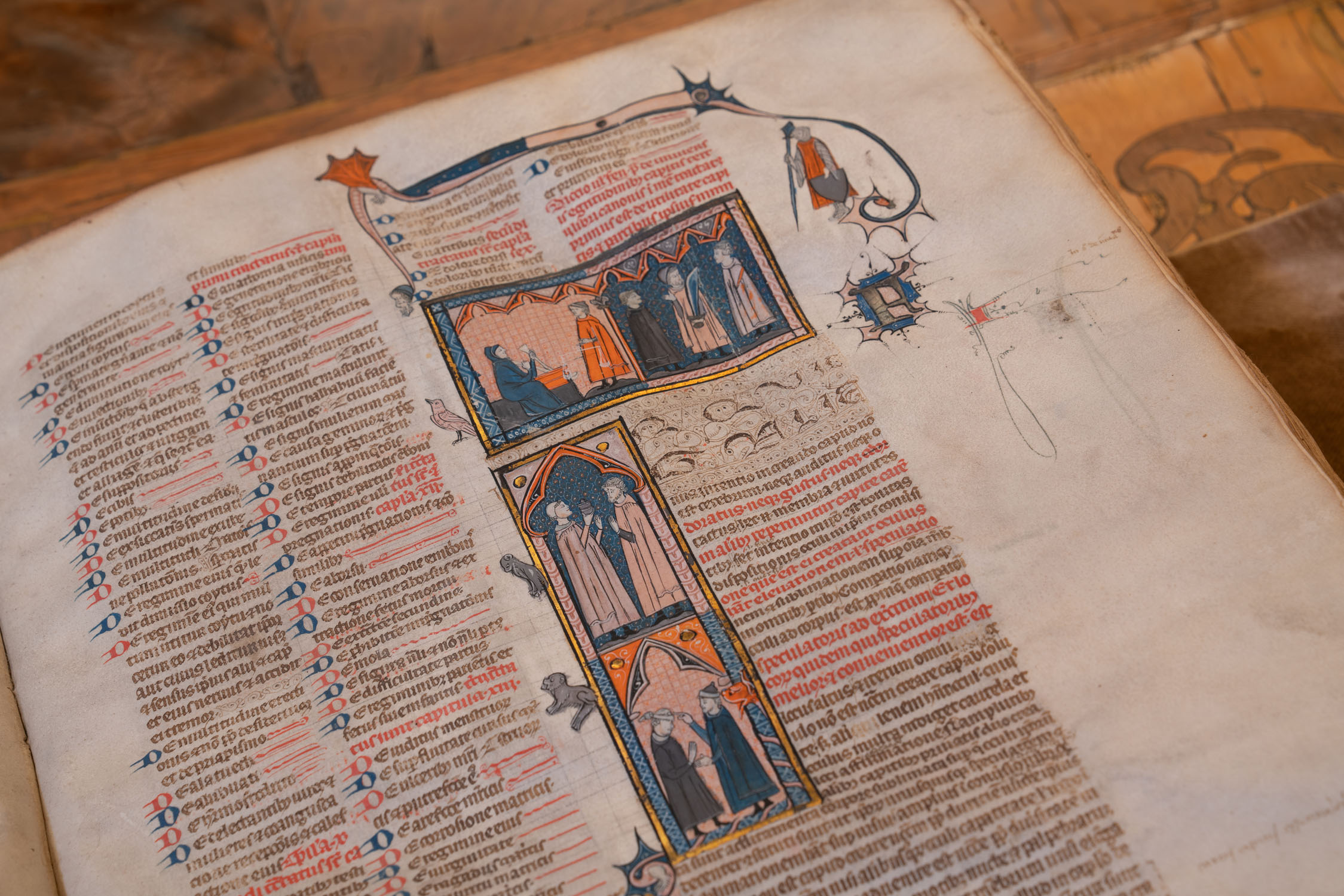
The collection, divided into three sections, includes 20,000 volumes, among which are 375 manuscripts, 1,628 sixteenth-century books, and around 60 incunabula. Among the most important items are the illuminated manuscript "Liber fraternitatis Sancti Spiritus in Saxia de Urbe" (15th century) and the illuminated manuscript of Avicenna (13th century). Specialized in the History of Medicine and Science, the Library takes part in the National Census of Manuscripts and Sixteenth-century Books.
Points of interest
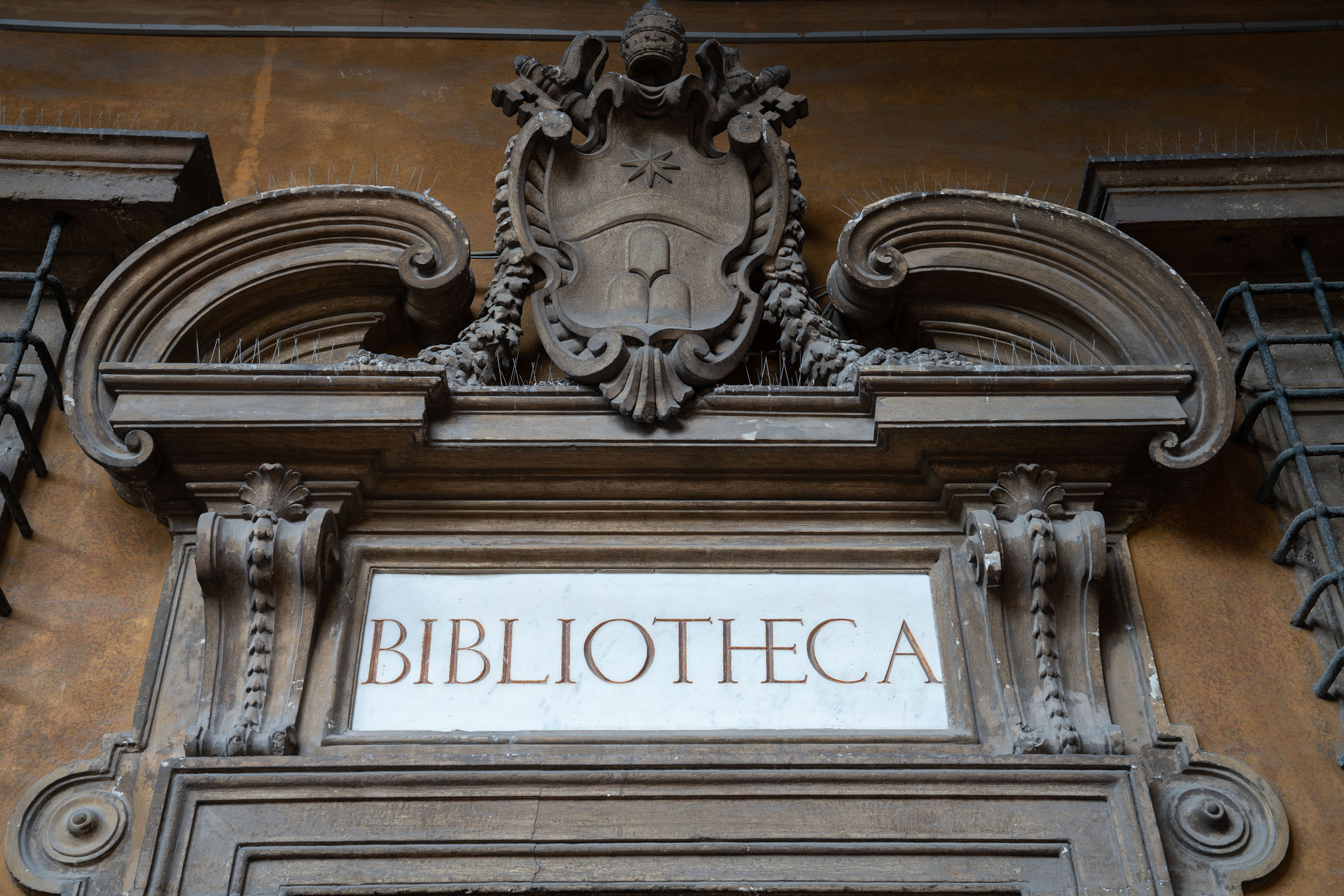
Atrium and Vestibule of the Library, 18th-20th Centuries
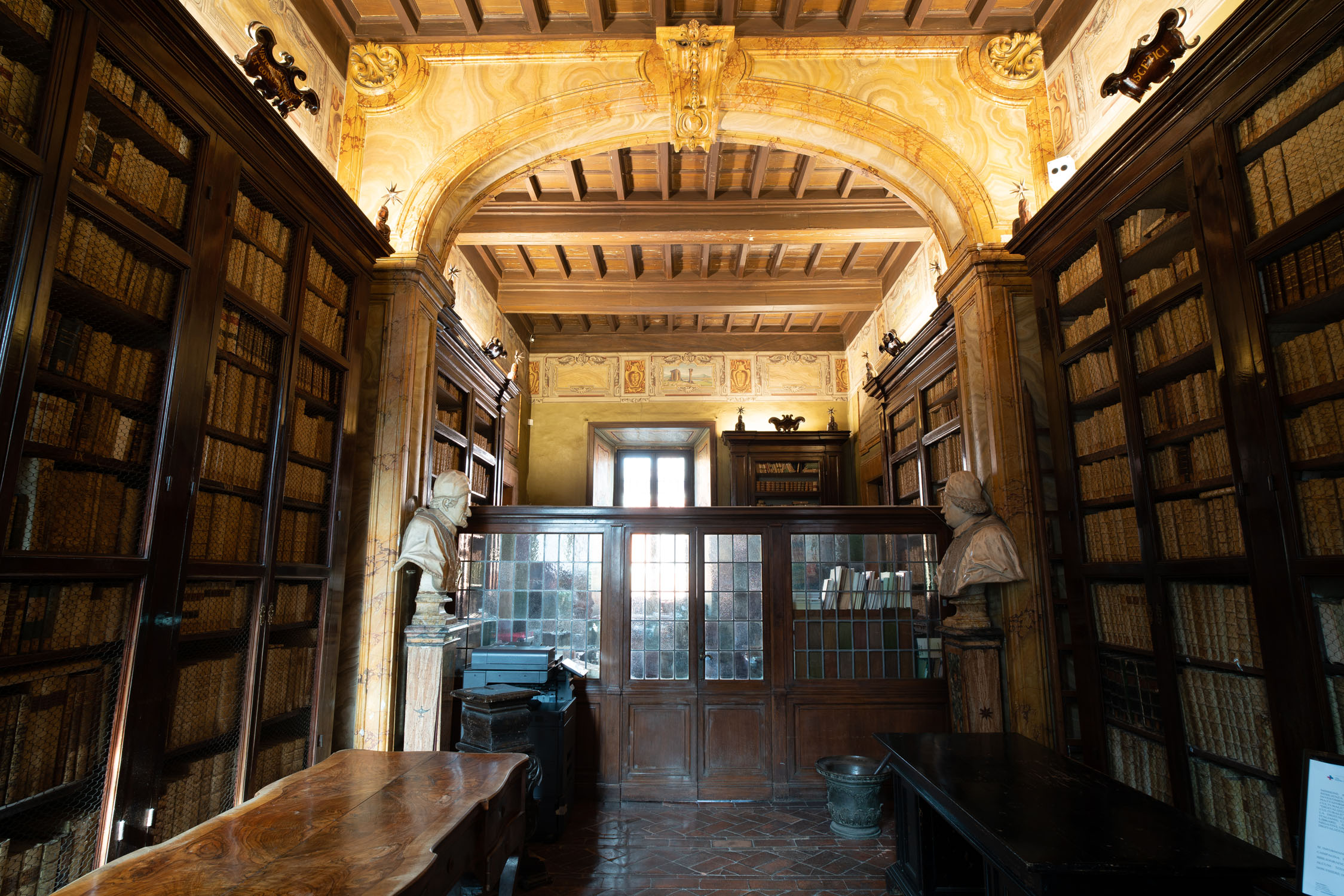
In the atrium and vestibule of the Lancisiana Library unfolds the grand 18th-century wooden shelving, surmounted by cartouches bearing the names of various disciplines in gold lettering. Since its founding, the library has preserved its precious codices within these bookcases. At the center of the hall, flanking the large full-arch doorway, stand the busts of the popes whom Giovanni Maria Lancisi served as papal physician: Clement XI (Gian Francesco Albani) and Innocent XI (Benedetto Odescalchi). Carved in marble by artists from the Roman school in the first half of the 18th century, these busts reflect the stylistic principles of the Bernini school. The presence of mortars and pharmaceutical ceramics (16th-19th centuries) serves primarily to highlight the close connection between academic study and pharmaceutical practice
Ceiling of the Reading Room, Gregorio Guglielmi, 18th Century
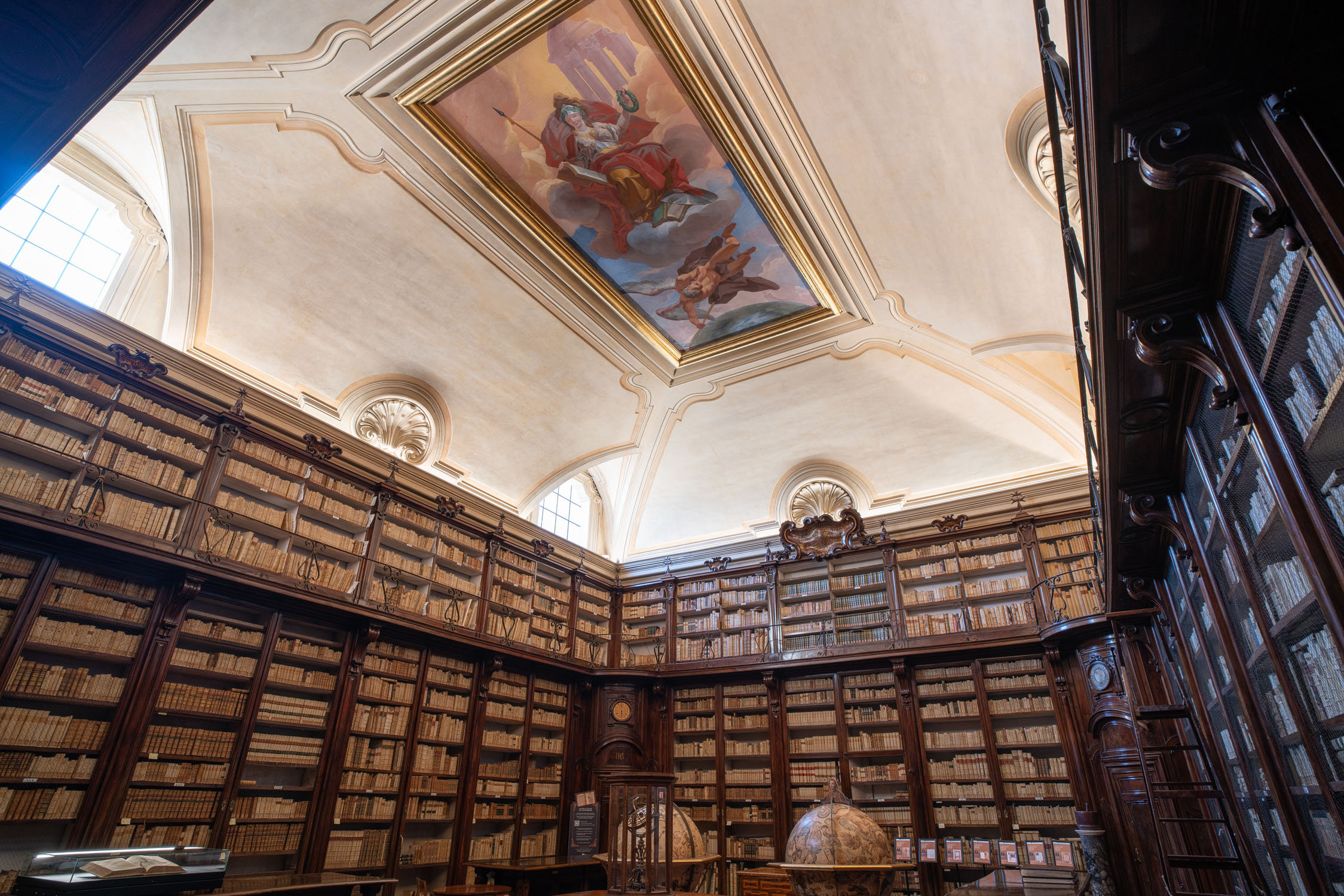
The artist Gregorio Guglielmi was active in Rome until around 1751. Between 1745 and 1748, he painted the fresco Wisdom Banishing Ignorance on the ceiling of the Lancisiana Library. From the same period dates his fresco cycle of 32 scenes depicting Prophets, the Life of Christ, and the Stories of the Apostles in the wing of the Ospedale di Santo Spirito in Sassia, commissioned by Pope Benedict XIV. This cycle was destroyed in 1908.
Reading Room of the Library, Tommaso Mattei, 18th Century
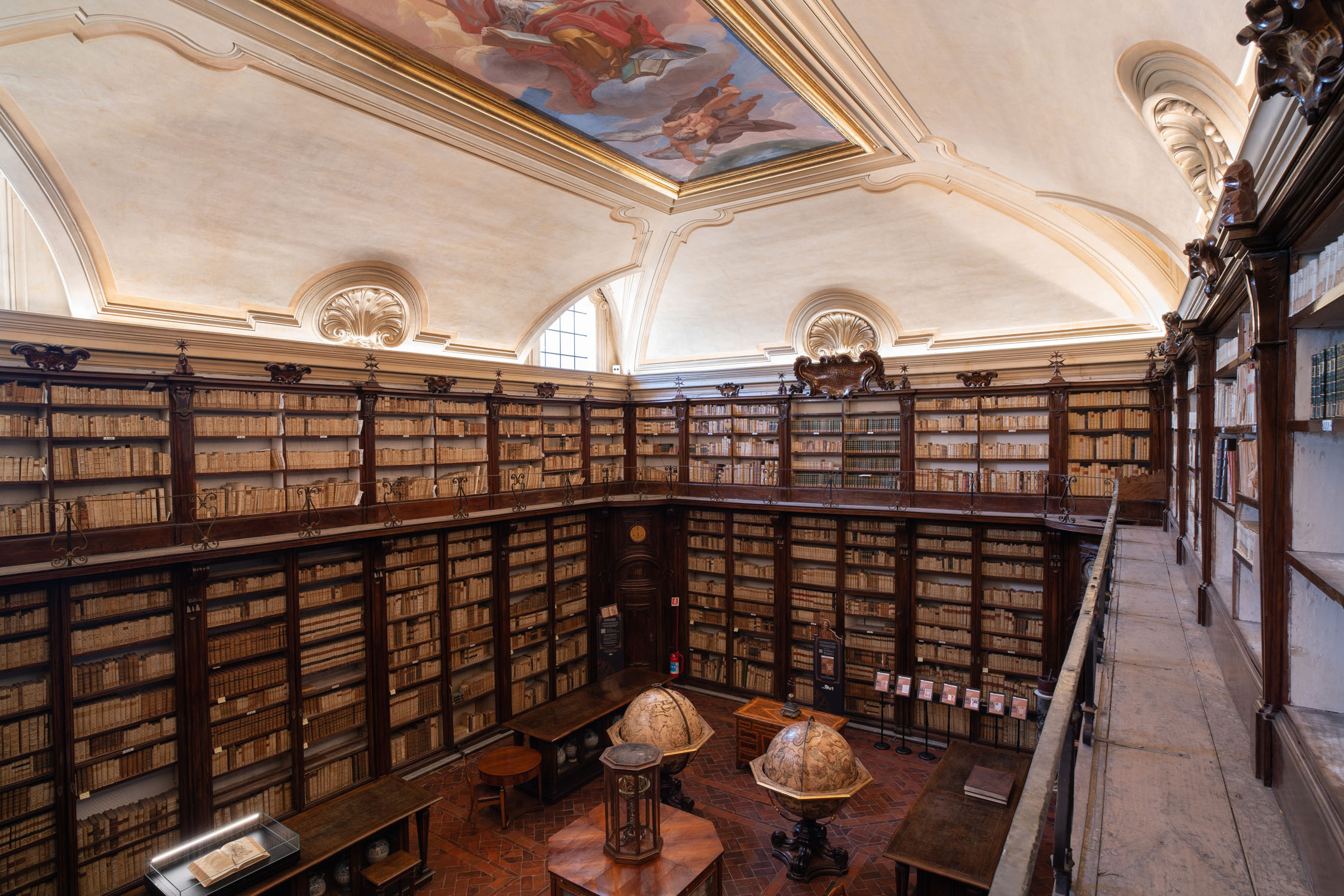
Tommaso Mattei, a pupil of Carlo Fontana and Carlo Rainaldi, was active in Rome during the Baroque period. As the architect of the Ospedale di Santo Spirito at the end of the 17th century and between 1707 and 1717, he is credited with the redesign of the Lancisiana Library, including its wooden shelving resting on a marble base. The shelving consists of a continuous series of armaria arranged in two tiers, separated by a cornice. Above this, a wrought-iron railing runs along the upper level, accessible via a spiral staircase.
Celestial Globe and Terrestrial Globe, Vincenzo Maria Coronelli, 17th Century
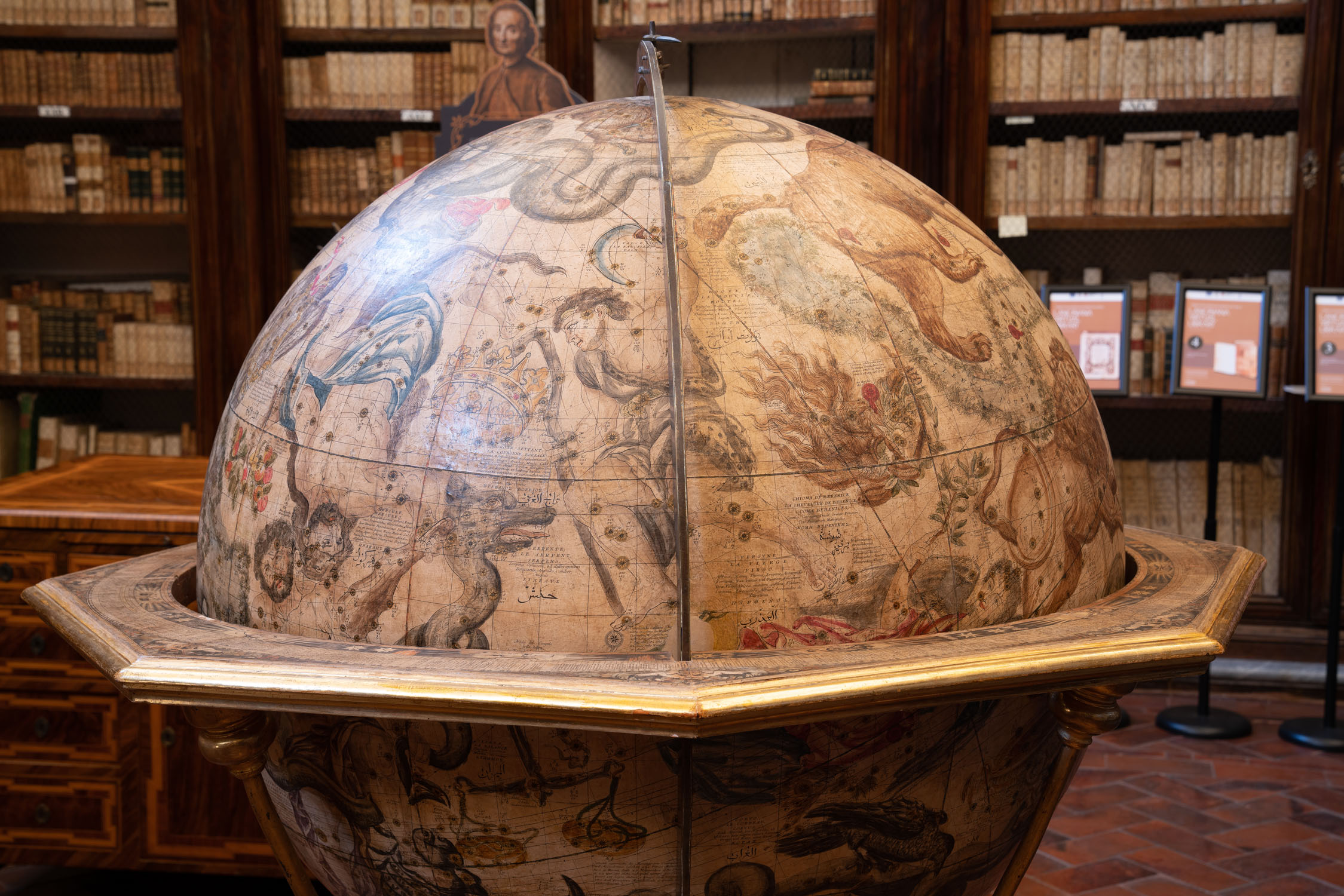
The globes in the Lancisiana Library, created by Vincenzo Maria Coronelli, were gifted to Giovanni Maria Lancisi by the Doge of Venice, Francesco Morosini, on the occasion of the library’s inauguration. Each globe is supported by four gilded metal arms extending from a carved base to hold the horizon/equator. The meridian is made of brass, as is the northern disk, which bears engraved hour markings. The Franciscan friar Vincenzo Maria Coronelli was a renowned Venetian cartographer and geographer. Even Louis XIV invited him to his court. He began constructing terrestrial and celestial globes in 1678 and went on to produce more than 200 maps. For the Sun King, he created two enormous globes—one terrestrial and one celestial—each about 5 meters in diameter.
Armillary Sphere, Simone Barocci (attrib.), 16th Century
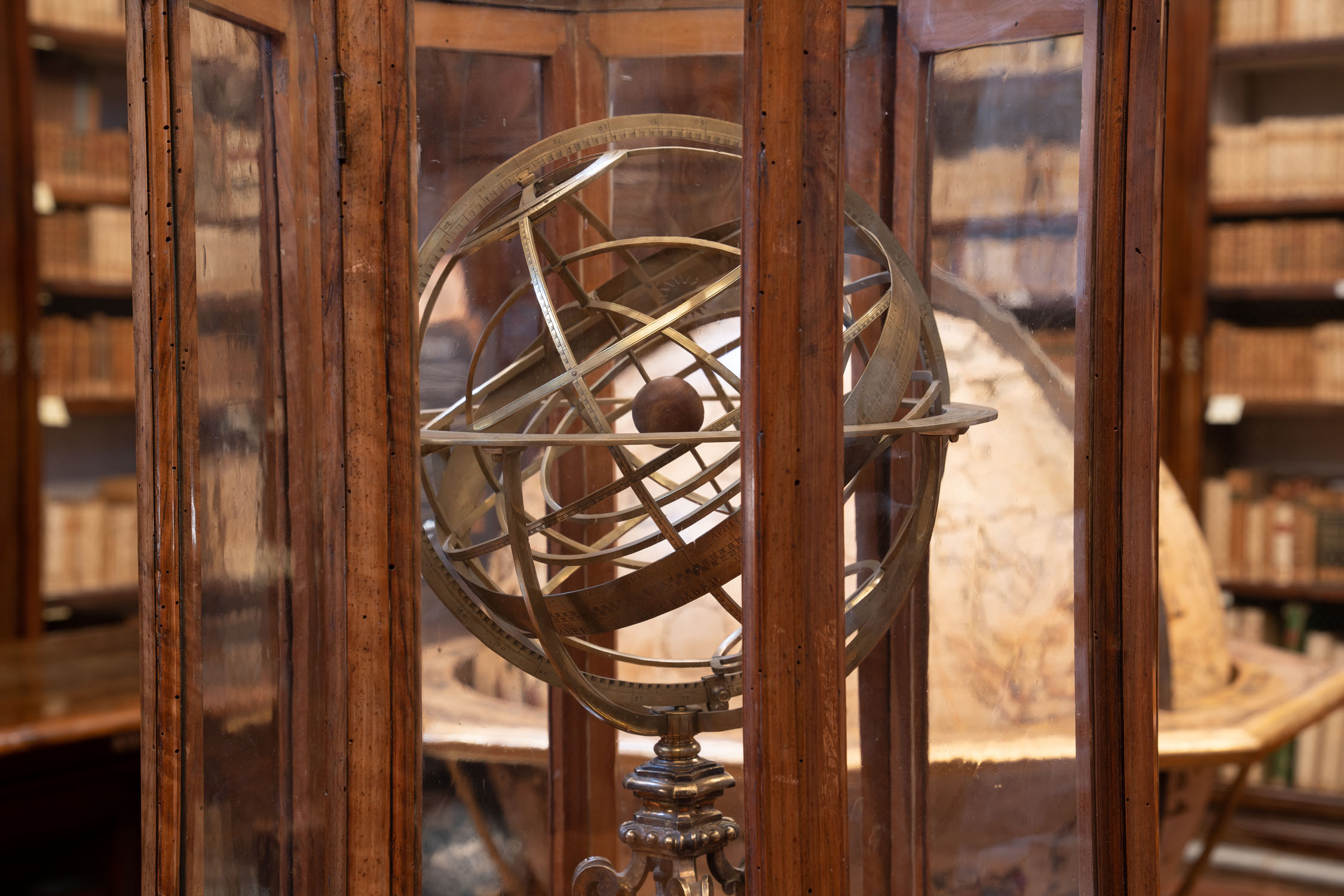
The armillary sphere was part of the collection of scientific instruments with which Lancisi equipped the library. Created in the 16th century by Simone Barocci from Urbino, it was used to demonstrate and study the movements of the celestial sphere in relation to the Earth, which was placed at the center. Composed of a framework of graduated metal rings (armillae), the artifact reflected the state of astronomical knowledge in the mid-16th century, still based on the geocentric model of the universe.
Secret Window, 17th Century
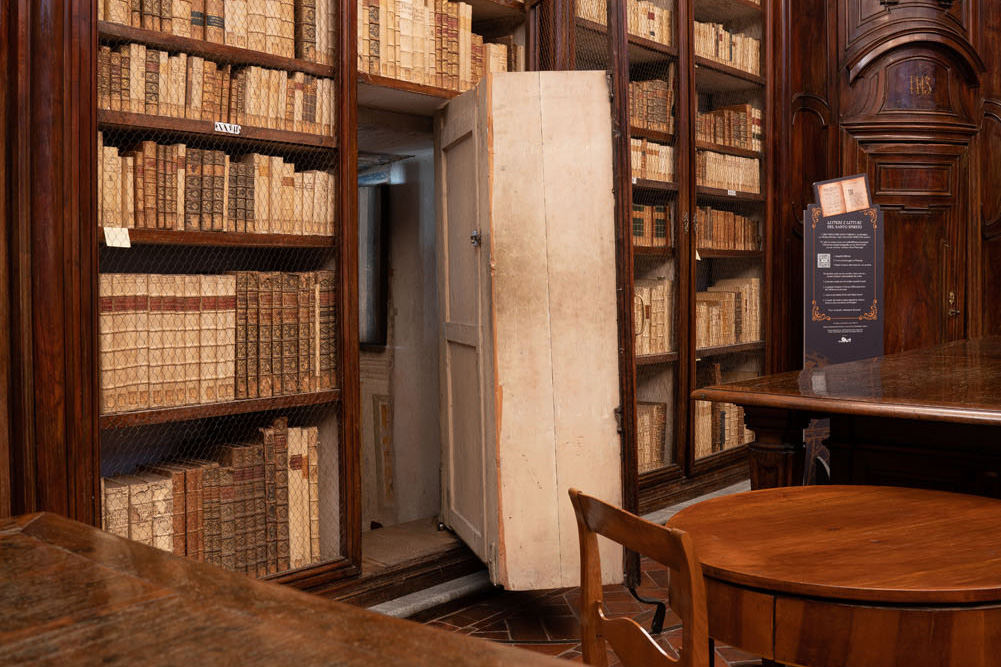
Bookshelf XXVI of the Lancisiana Library conceals a secret window overlooking the Sistine Wards. Commissioned in the 17th century by Commander Giovanni Battista Spinola, it allowed him to discreetly observe the work of the medical staff responsible for patient care, ensuring their actions adhered to the Regulae, the official administrative regulations.
Anathema Cartouche Against Book Extractors, 18th Century
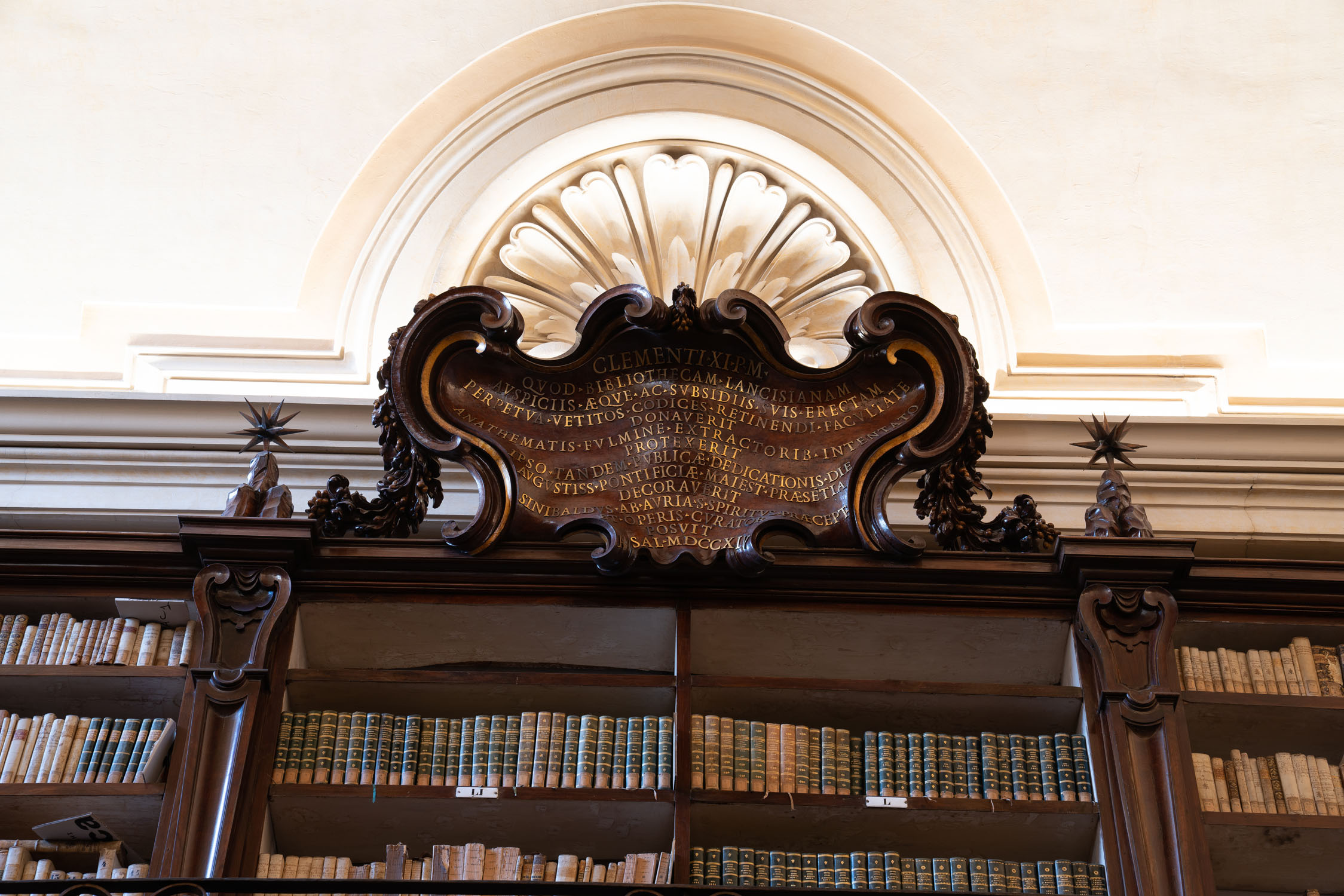
The large wooden cartouche crowning bookshelves L and LI was commissioned by Commander Sinibaldo Doria to commemorate the inauguration ceremony of the Library and the privileges granted, including the right to retain prohibited books. It also bears the excommunication decree against those who illegally removed volumes.
Codex Liber Fraternitatis, 15th Century
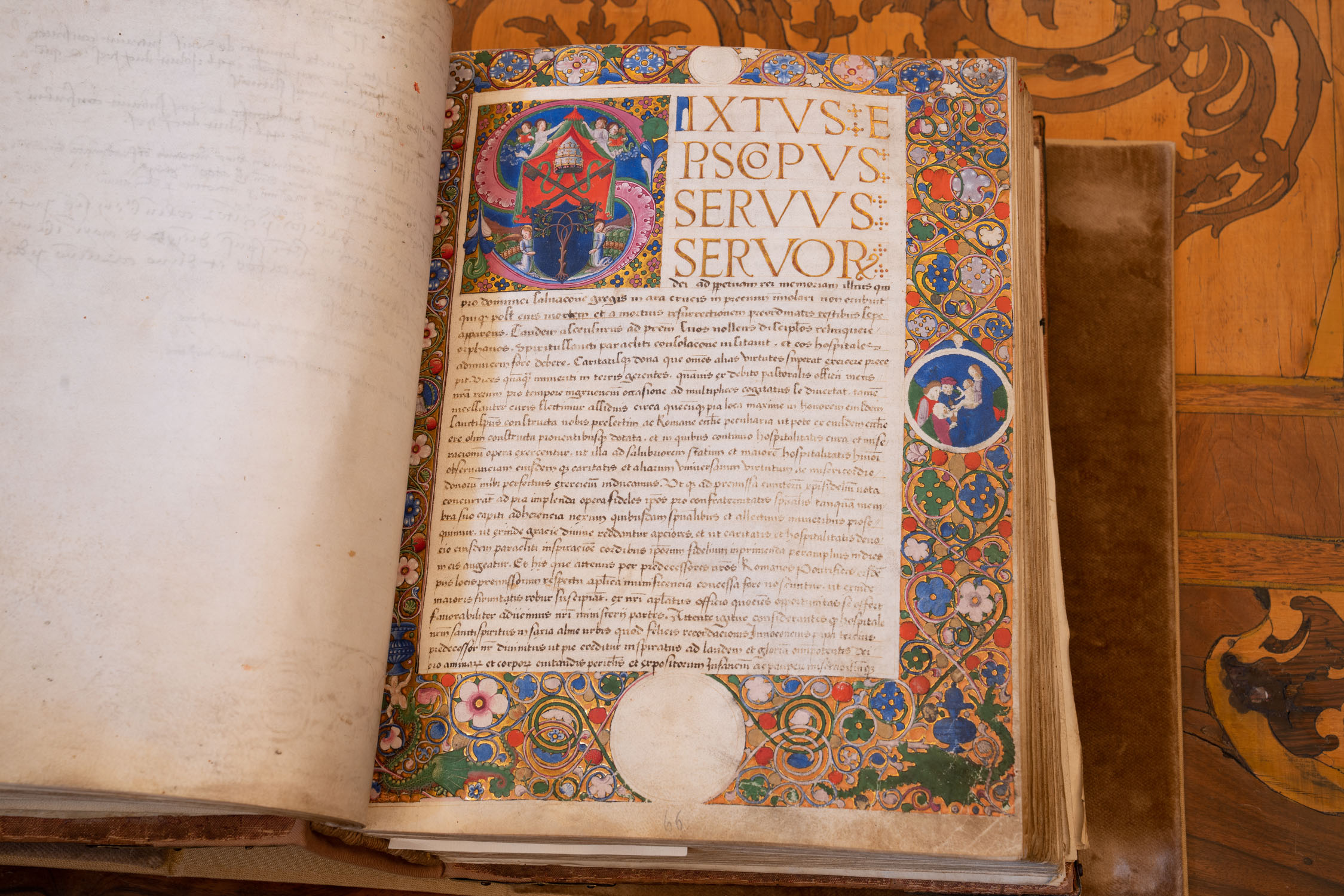
The Liber Fraternitatis is a handwritten codex dated 1446, composed of approximately 500 sewn parchment leaves. It preserves the two papal bulls of Eugene IV and Sixtus IV, issued for the renewal of the Hospitaller Order of Santo Spirito and its associated confraternity, along with autographs from both humble devotees and prominent figures from the social and political spheres. The confraternity members were required to serve at least once a year in the hospital, seek out the poor and needy in the streets and homes, assist with burials, and collect alms for the institution. Over time, signatures from renowned personalities and rulers from Italy and across Europe were added. The codex also includes the signature of Pope Saint John Paul II. This precious manuscript features two illuminated incipits at the beginning of the bulls that reestablished the hospital: one issued by Eugene IV in 1446 and the other by Sixtus IV in 1478, both followed by the signatures of the pope and the cardinals.
Codex of Avicenna
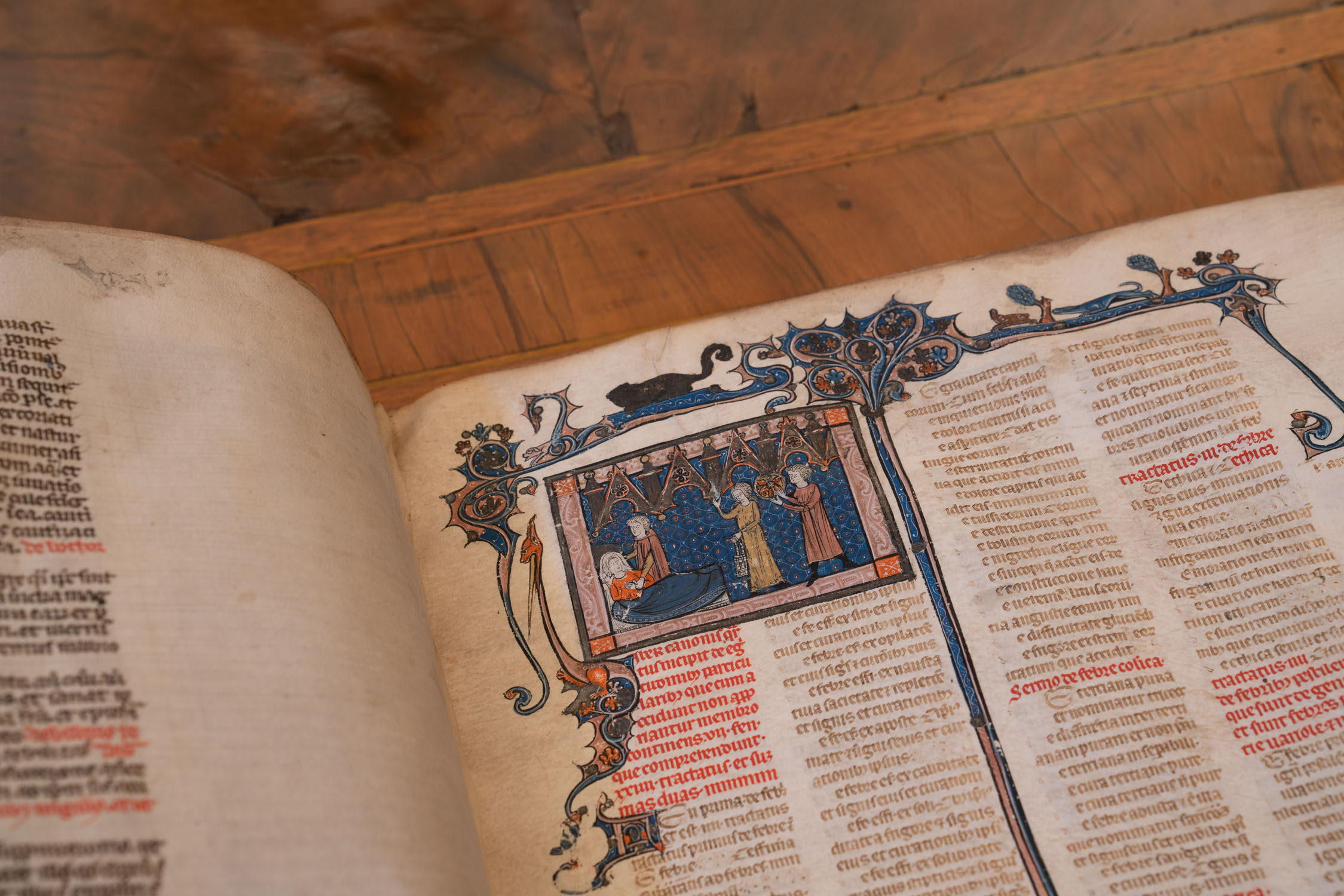
The Codex of Avicenna is a 13th-century parchment manuscript preserving the Latin translation of the most renowned work by the celebrated physician Avicenna: The Canon of Medicine. Within the Canon, Avicenna recorded his theoretical studies on clinical experimentation, of which he was a forerunner. The work is structured into five main books, superbly decorated with illuminated incipits.