
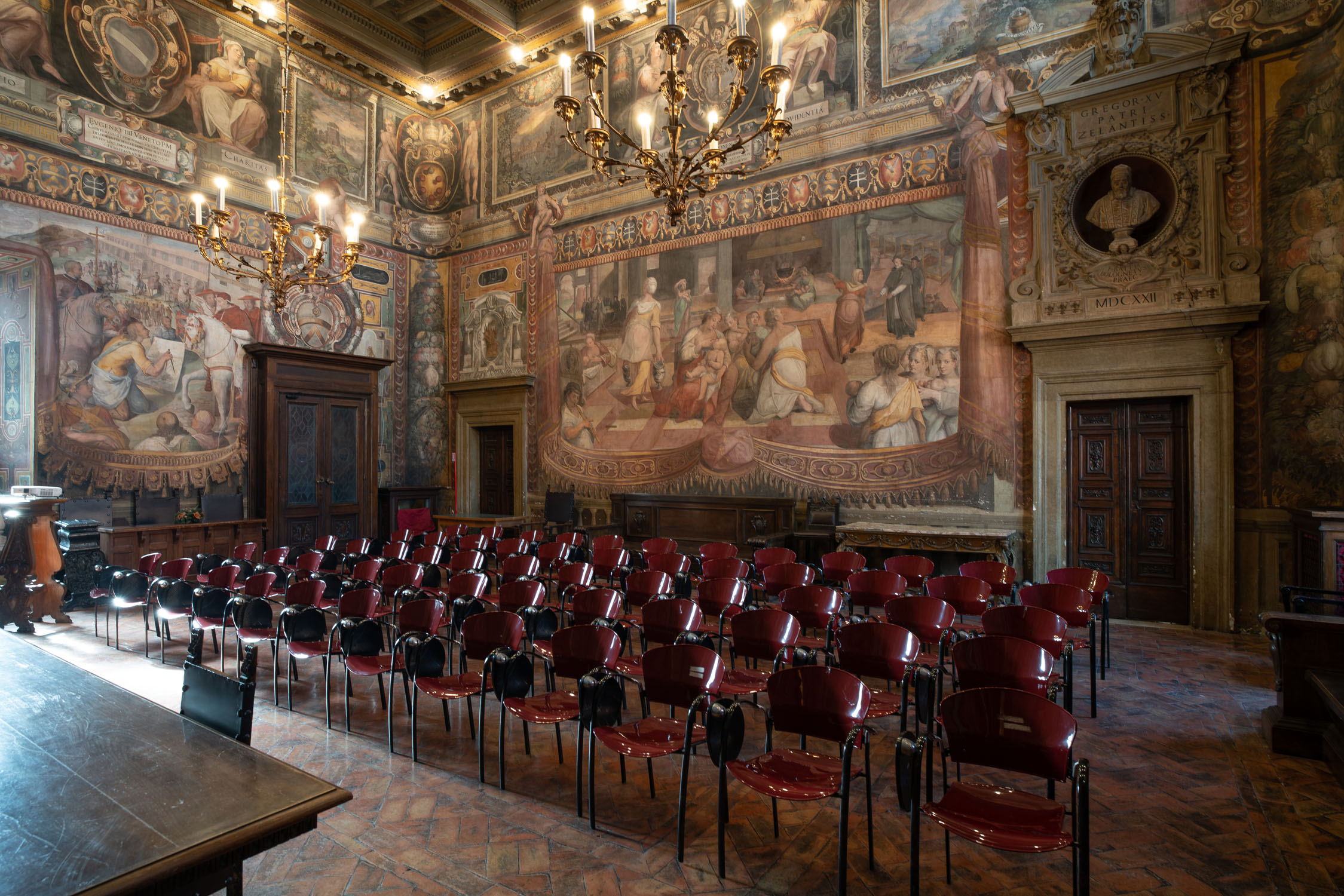
During his tenure as Commendatore, Teseo Aldrovandi, in addition to commissioning the loggia decorations from the modestly known artist Ercole Perillo, also took great care in the embellishment of the Salone, the most prestigious room in his residence. For this task, he entrusted artists of a much higher caliber. The majority of the paintings in the Salone are attributed to the brothers Jacopo and Francesco Zucchi. The scenes depicted retrace the history of the hospital, from its initial construction under Pope Innocent to its final Sistine expansion, illustrating the medical care and hospitality that define its mission. Today, the Salone serves as a conference hall and is connected to the adjacent Biblioteca Lancisiana, which was once an integral part of the Commendatori’s private quarters.
Points of interest
Façade of the Palazzo del Commendatore on Borgo Santo Spirito
The palace acts as a connecting element between the building of the Sistine Wards and the Church of Santo Spirito in Sassia. It is linked to the church by a structure featuring a large Serliana window.* The palace’s linear and distinctly Renaissance design was executed by Nanni di Baccio Bigio, a pupil of Sangallo. The façade, framed at both ends by rusticated quoins and divided into two levels by a double cornice, features kneeling windows* on the ground floor. These windows create a vertical thrust that is echoed by the noble floor’s windows and balanced by the smaller, square mezzanine openings. Crowning the imposing building is an elaborate cornice adorned with egg-and-dart and dentil moldings, one of the façade’s most distinctive elements, along with the monumental rusticated portal, surmounted by the emblem of the hospital, which serves as the entrance to the courtyard. * The Serliana is an architectural element consisting of a large central semicircular arch flanked symmetrically by two smaller openings topped with a lintel. ** A type of window commonly used on ground floors: its sill rests on protruding supports resembling those of a kneeling bench.
Interior of the Courtyard
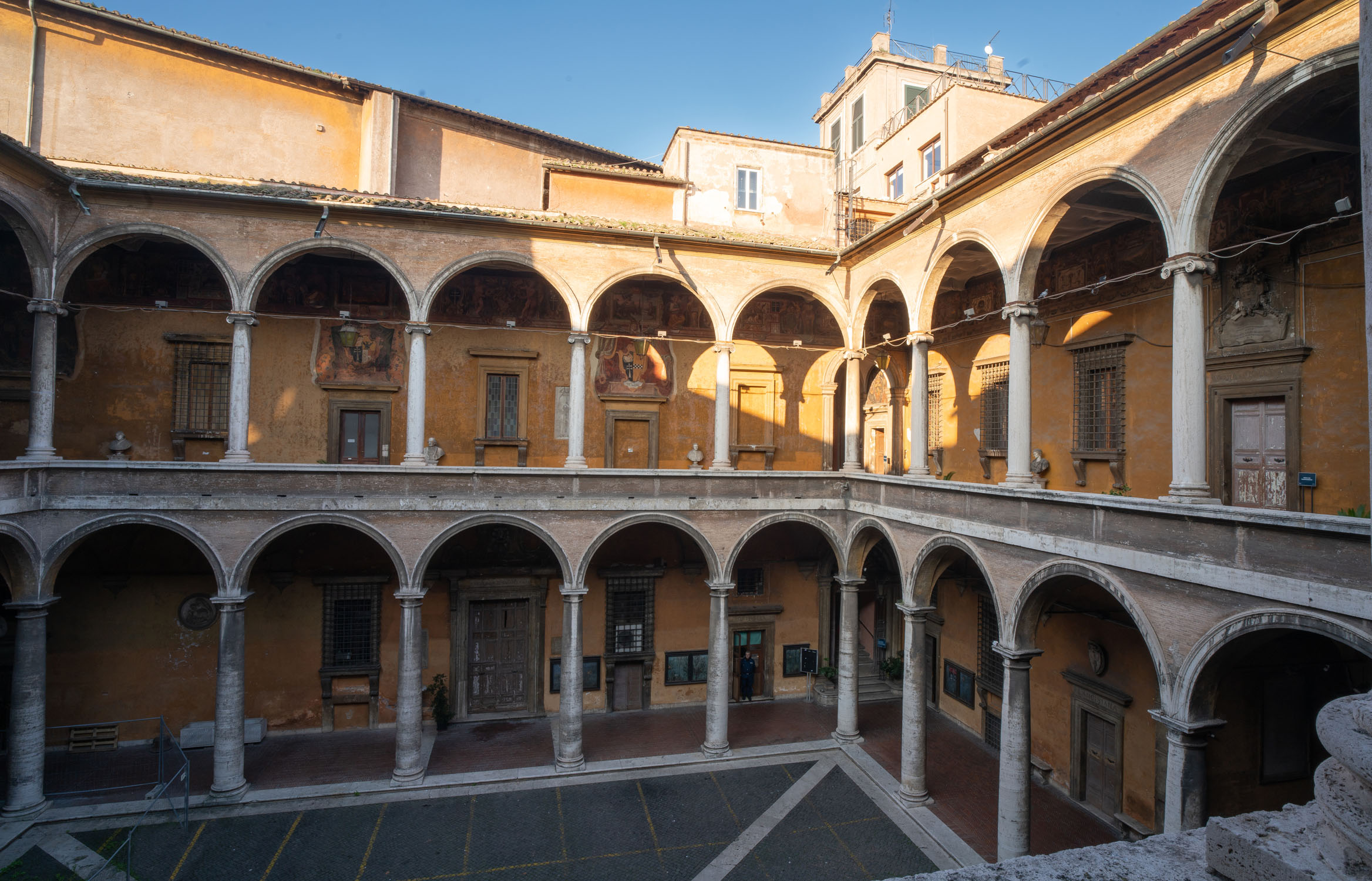
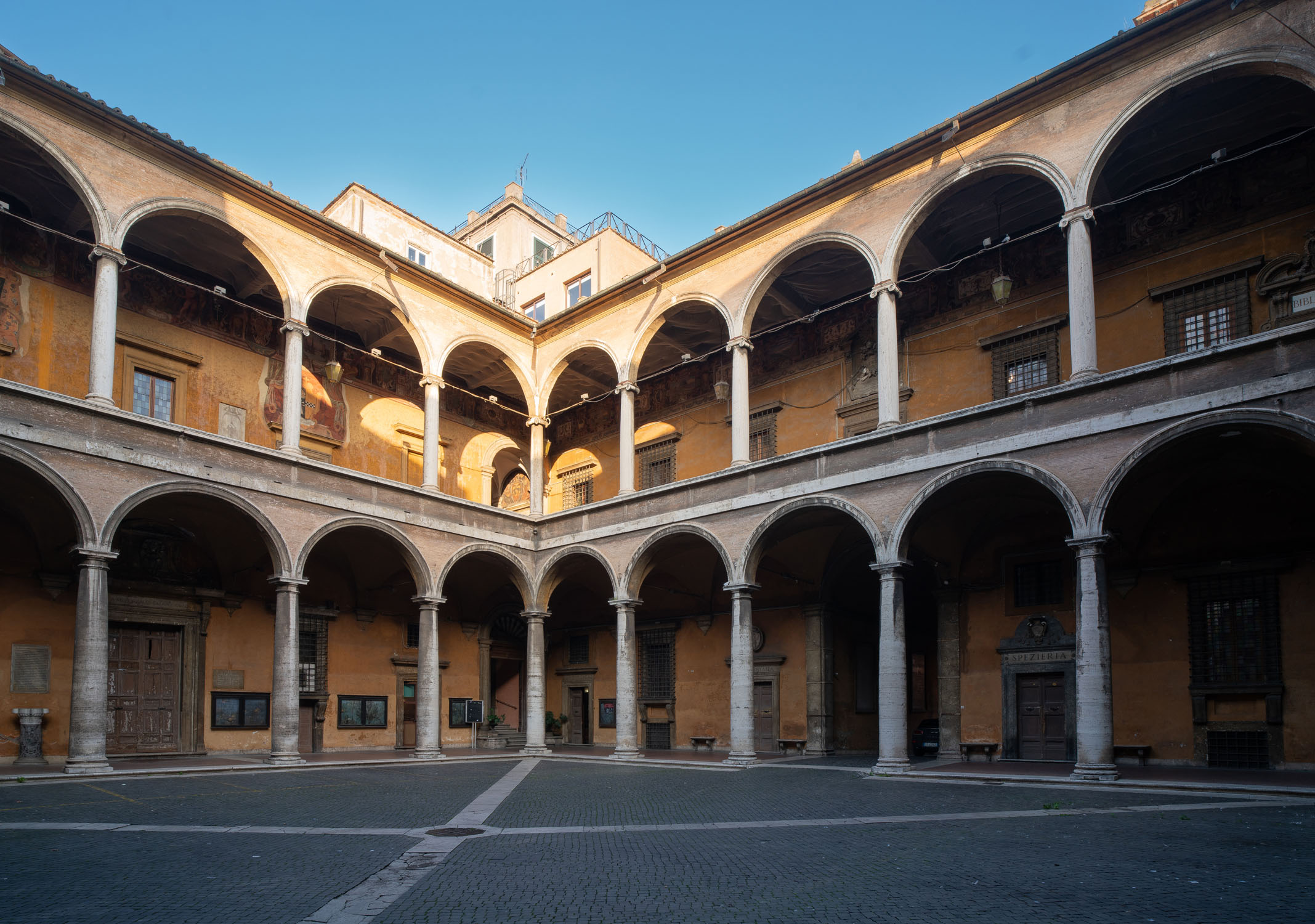
From the main portal, a barrel-vaulted passageway leads into a spacious double-porticoed courtyard, where semicircular arches rest on 20 columns—Doric on the ground floor and Ionic on the upper level. Along the portico, the monumental portals of Clement VIII and Alexander VII stand out, each surmounted by their respective coats of arms. These portals provide access to the church and the Sistine Wards, while additional doors lead to the Spezieria and the Accademia Lancisiana. On the central arch of the southern side, a marble coat of arms prominently displays the double-barred cross alongside a tower, the emblem of Commendatore Bernardino Cirillo, who oversaw the construction of the palace.
Fountain of Paul V
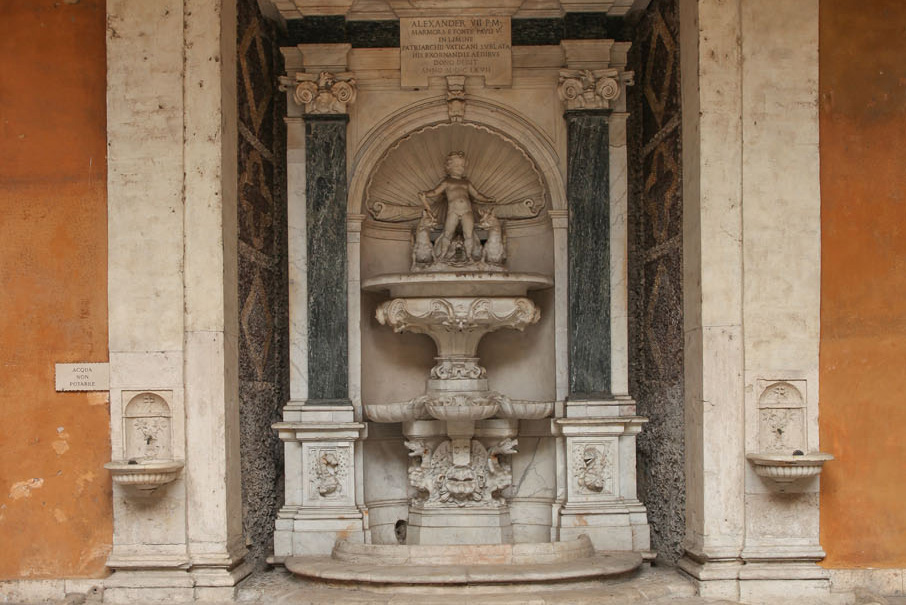
At the center of the south wall of the courtyard stands a monumental fountain. Originally placed at the entrance of the Vatican Palace by Paul V in 1614, it was removed during the construction of Bernini’s colonnade and later donated to the Palazzo del Commendatore by Alexander VII in 1677. The fountain is crowned by a broken pediment, at the center of which appears a dragon surmounted by an eagle, the heraldic emblems of Paul V. On either side, two pilasters in gray marble with Ionic capitals frame the composition. Below the dedicatory inscription of Alexander VII, within a shell-shaped niche, a cherub holding a cornucopia is flanked by two small dragons. Beneath him, two grotesque faces support a basin from which water once flowed into three smaller basins below. The entire structure is completed at the bottom by a large mask set into the semicircular collection basin.
Clock
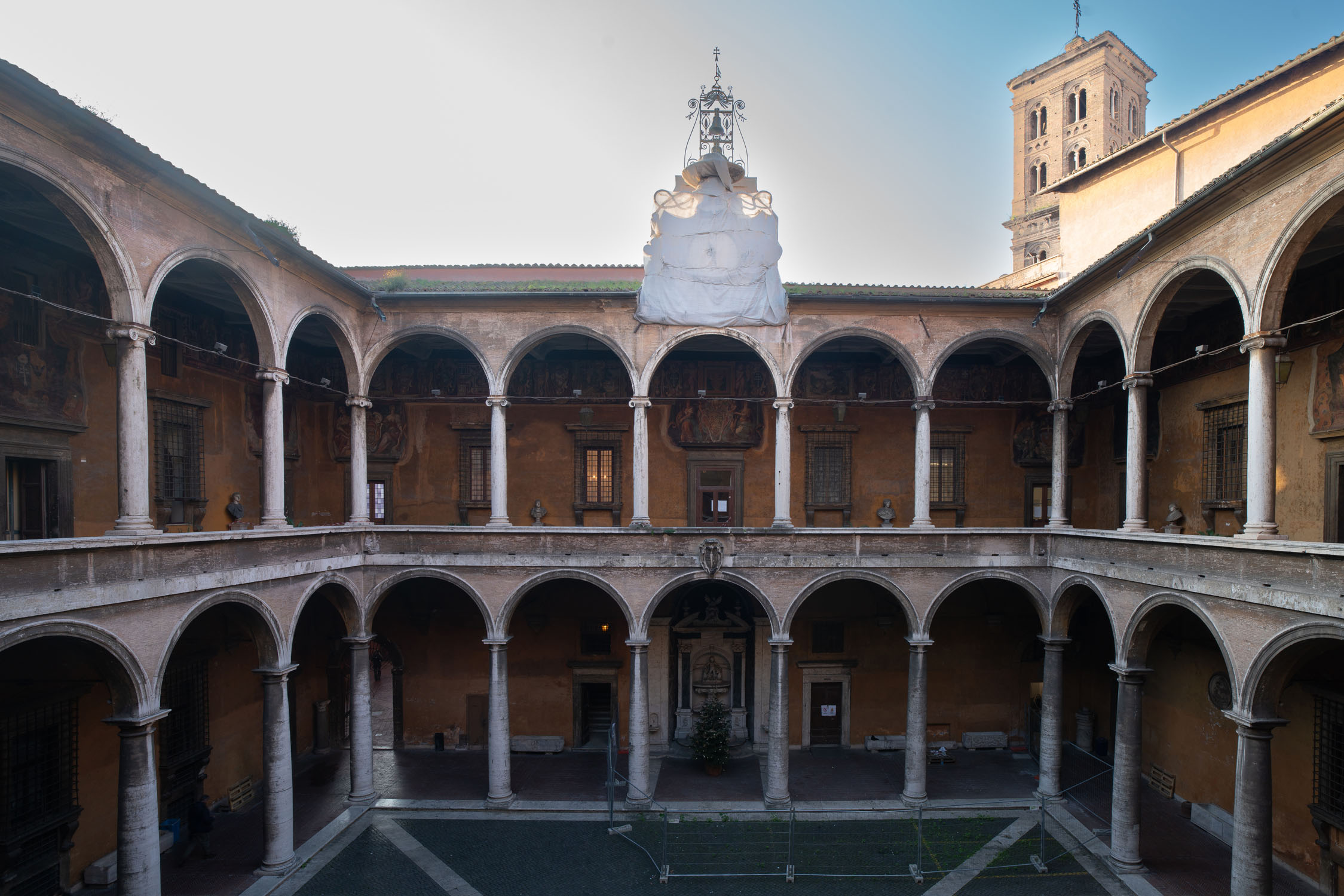
The south side of the portico is dominated by a clock commissioned by Commendatore Antonio Maria Pallavicini. The large dial, divided into six hours and framed by a serpent, features a single hand in the shape of a lizard. During the French Republic, the dial was altered to a twelve-hour format but was later restored to six hours, even after Pope Pius IX mandated the adoption of the French time system in 1846.
Decorations and Coats of Arms of the Piano Nobile
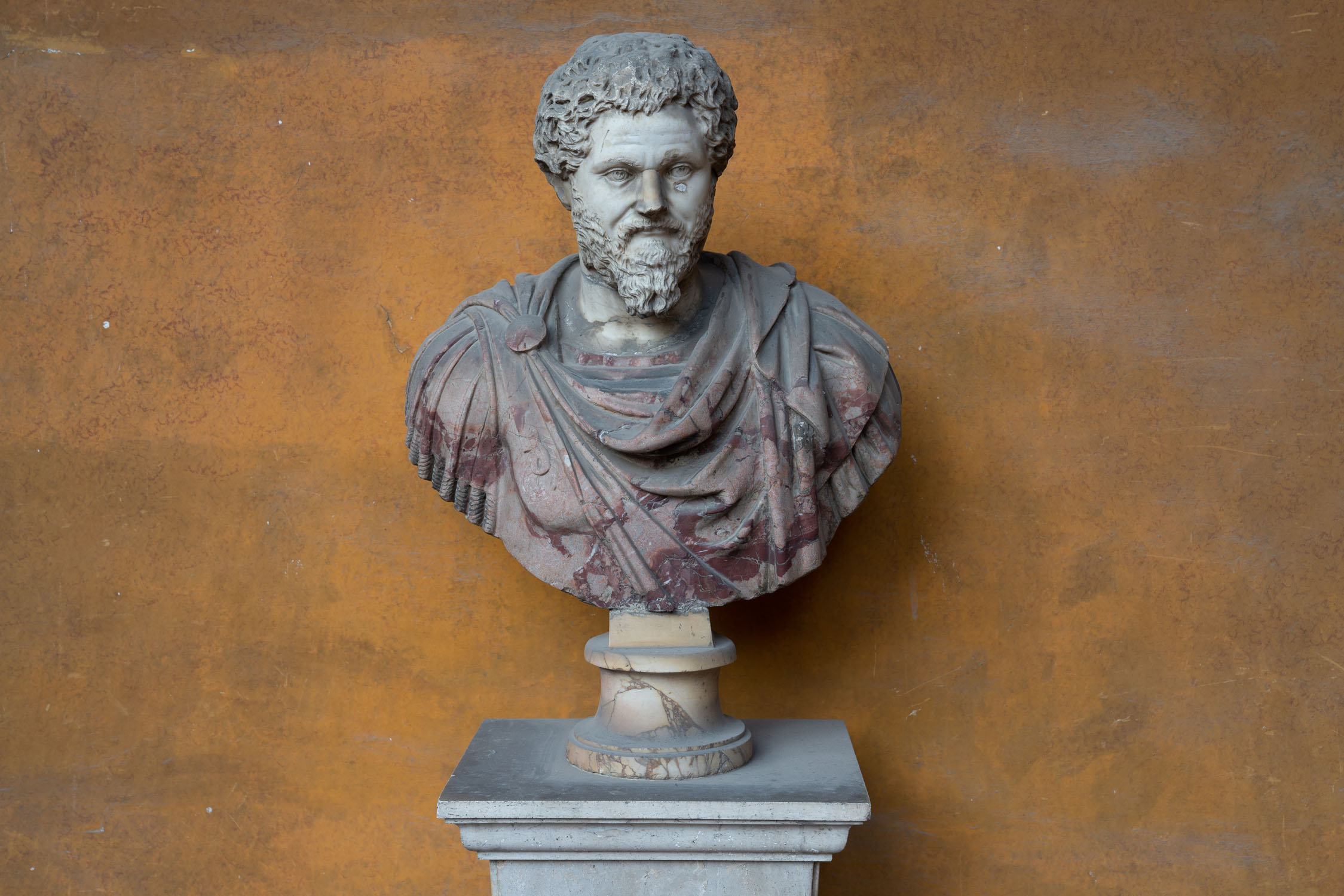
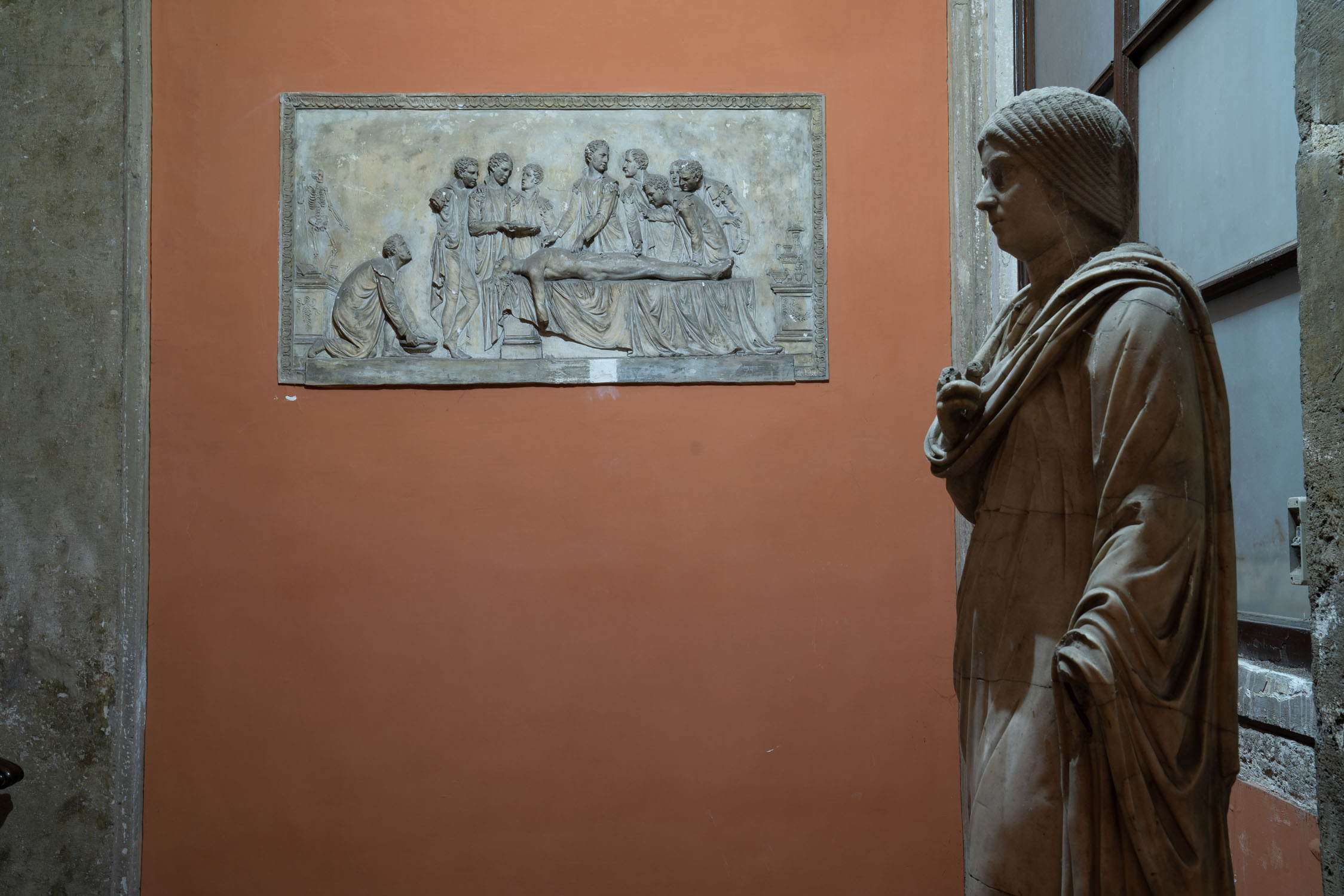
The walls of the piano nobile loggia are adorned with a continuous painted frieze that runs along its entire perimeter. The decoration features noble coats of arms belonging to commendatori, such as Cardinal Pietro Campori, Cardinal Spinola, and Cardinal Agucchi, as well as those of popes, including Innocent III of the Conti di Segni, Paul V Borghese, and Urban VIII Barberini. These are interspersed with grotesques, allegorical female figures, and landscapes—both real and imaginary—that reflect the emergence and spread of this innovative pictorial style, influenced by the presence of Flemish artists in Rome, such as the brothers Paul and Mattheus Brill. The painting style is quick and simple, suited to the loggia of a hospital and demonstrating a conscious effort to contain costs and avoid criticism. Along the loggia walls, three busts of popes—Pius VI Braschi, Pius VIII Castiglioni, and Pius IX Mastai Ferretti—are displayed alongside six 18th-century busts representing Roman emperors. The loggia also provides access to the portals of the Salone del Commendatore and the Biblioteca Lancisiana.
Overall View of the Salone
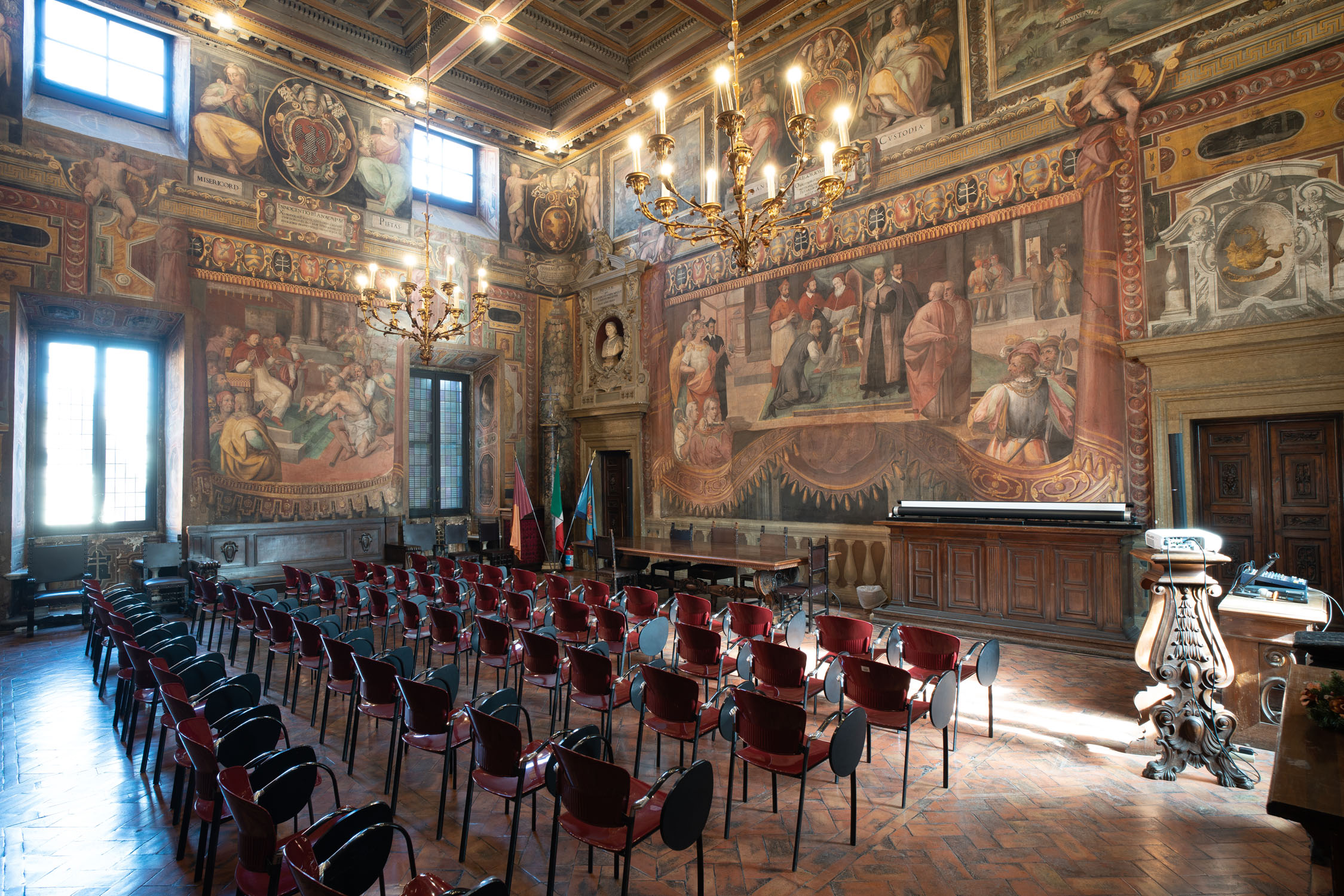
Through the portal leading from the loggia—crowned on the exterior by the coat of arms of Pope Clement XIV Ganganelli and on the interior by that of Teseo Aldrovandi—one enters a grand hall entirely adorned with frescoes. On the four walls, imposing illusionistic frames, designed to resemble richly draped tapestries, enclose life-sized scenes depicting the history and activities of the hospital. At the center of the high wooden coffered ceiling, a split coat of arms prominently features the heraldic insignia of Teseo Aldrovandi, flanked by the double-barred cross. Along the upper frieze of the walls, papal coats of arms alternate with imaginative landscapes of countryside and seascapes, accompanied by scrolls explaining their allegorical significance. These frescoes are attributed to the circle of Paul Brill, Cesare Arbasia, and Ercole Perillo.
The Dream of Innocent III and the Papal Coat of Arms
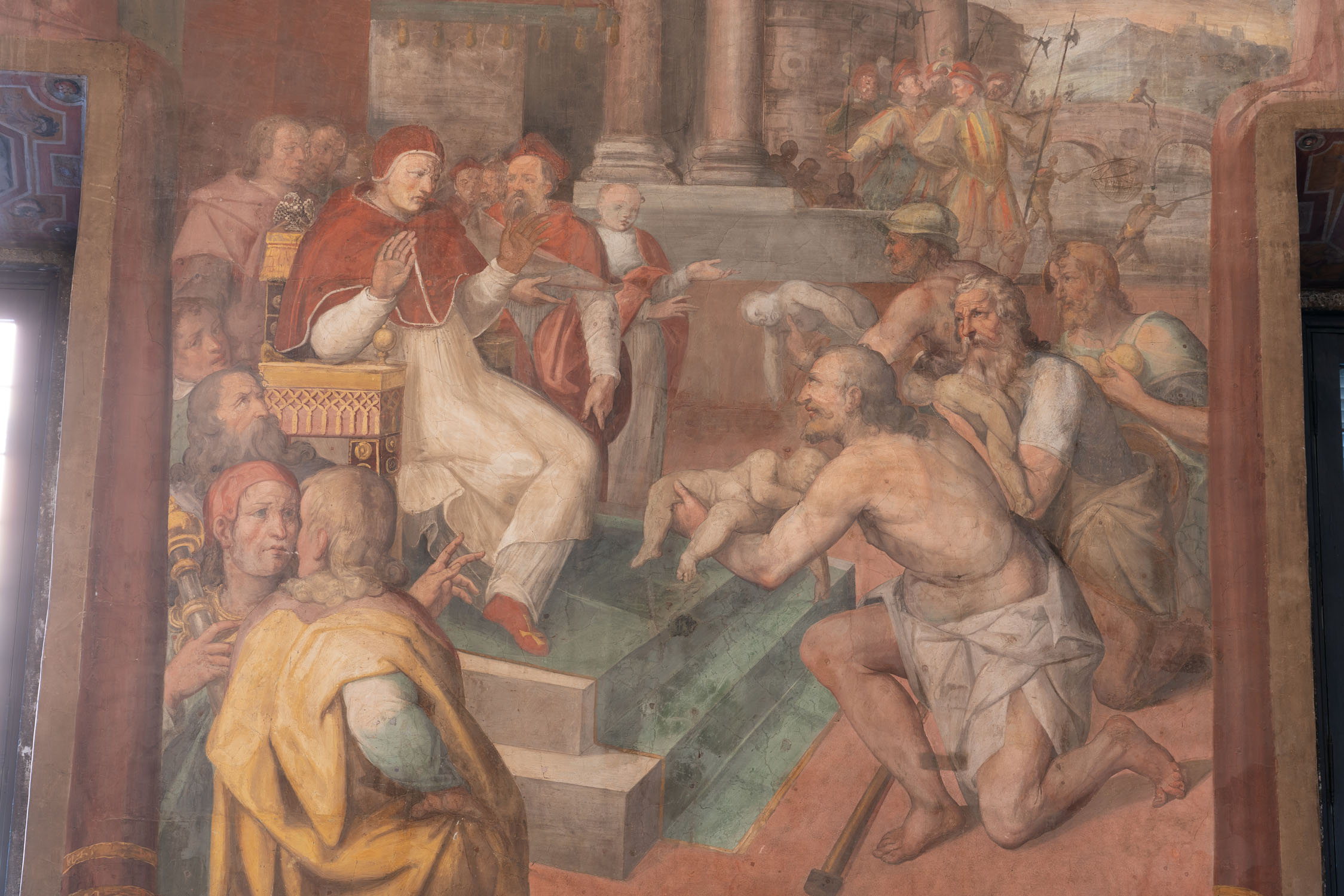
The large fresco on the north wall tells the story of the foundation of the Ospedale Innocenziano at the end of the 12th century, dedicated to Santa Maria in Sassia. It originates from the legend of the “macabre fishing”, a vision that appeared in a dream to Pope Innocent III. In this dream, fishermen recovered the bodies of newborns, cast into the Tiber by their own mothers, and presented them to the pope. In reality, during his pontificate, the hospital was reestablished as a place of refuge for abandoned infants, the poor, and single women, while also providing free medical care to the sick, regardless of social class. This initiative was based on the principle that illness should not be seen as divine punishment. Above the large fresco, two female figures—allegories of Misericordia and Pietas—stand alongside the heraldic emblem of Innocent III: a checkered black-and-gold eagle, symbolizing the pope’s mission.
Construction of the Wards and the Coat of Arms of Sixtus IV
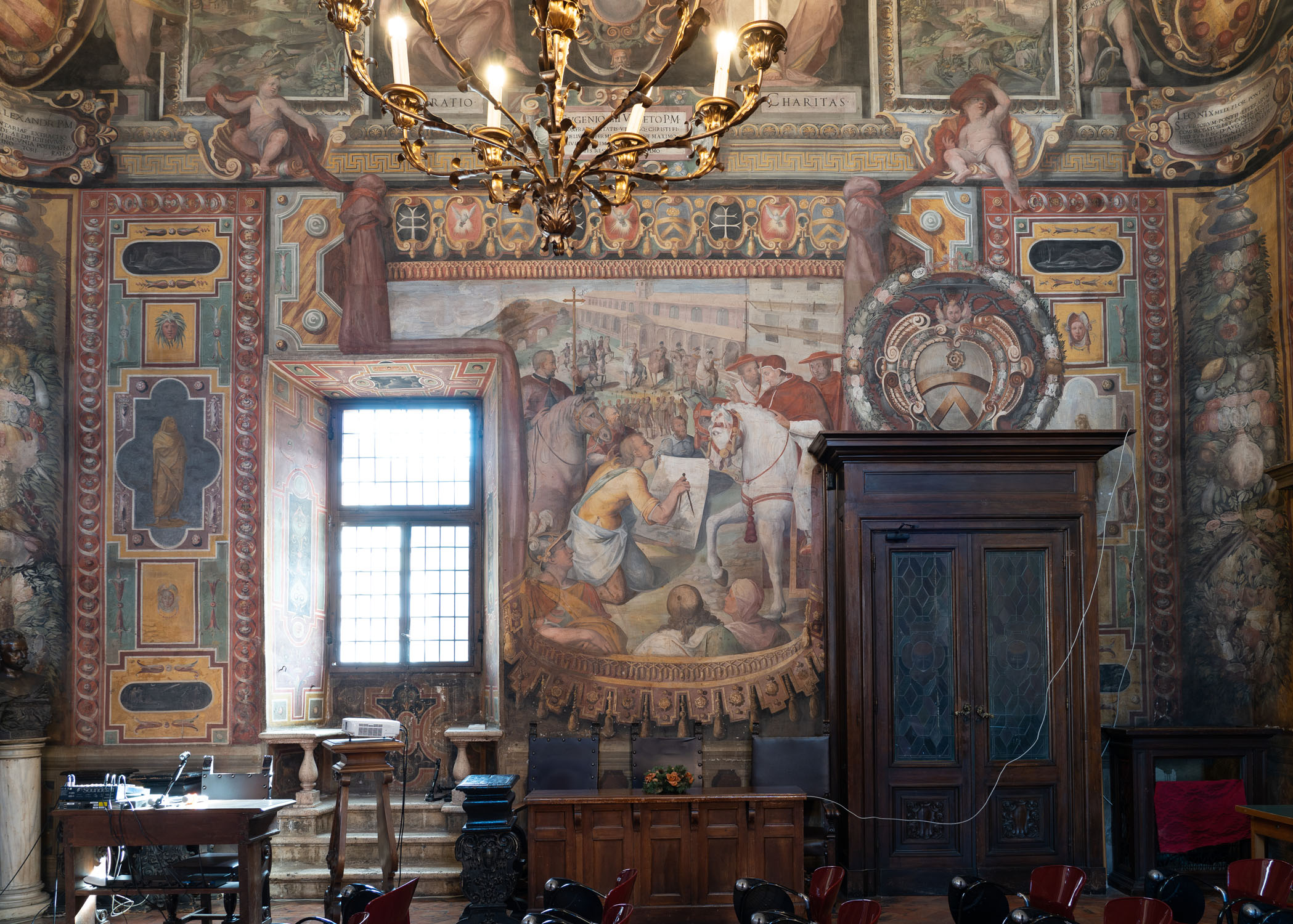
On the south wall, the fresco illustrates the next phase of construction of the new hospital, initiated by Sixtus IV della Rovere as part of the broader redevelopment of Rome and the Vatican area, beginning in the late 15th century. The fresco depicts the pope riding the chinea—a white horse traditionally reserved for monarchs and distinguished figures—accompanied by Cardinal Bessarion and the papal guard. Sixtus IV is shown in conversation with Baccio Pontelli, the renowned architect involved in various Sistine projects, who presents him with the plans for the new hospital wards, still under construction in the background.
Commendatore Aldrovandi and Pope Gregory XIII
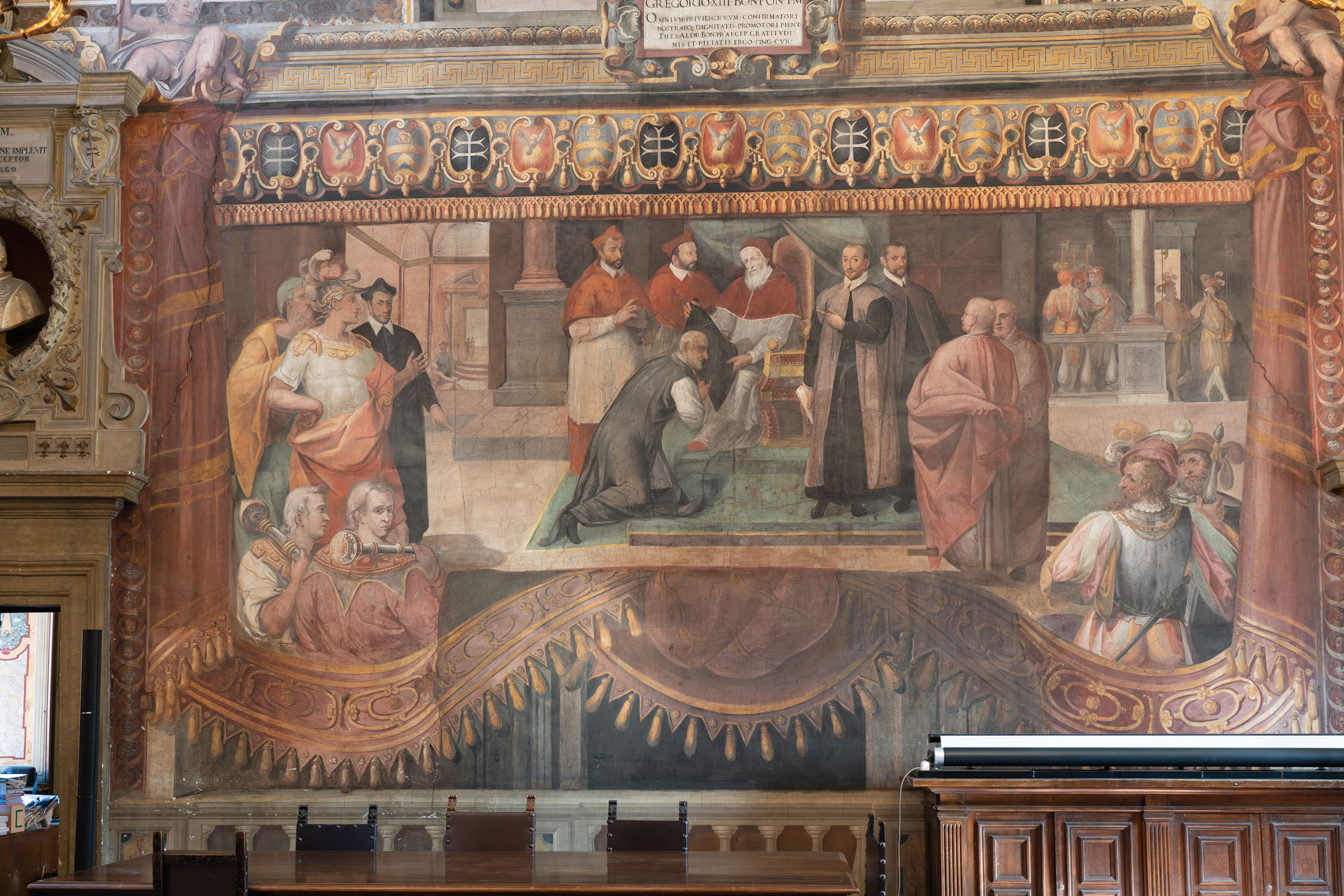
On the east wall, the papal coat of arms of Gregory XIII Boncompagni dominates the scene. It features a dragon surmounted by the triregnum and crossed keys, flanked by two female figures—allegories of Vigilance and Guardianship—which introduce the large fresco below, celebrating the pope’s conferment of the title of Commendatore upon Teseo Aldrovandi. The symbol of the title is a black cloth adorned with a white double cross. On the left side, two figures appear carrying seals, alongside a figure in armor with a plumed helmet, likely representing the city of Rome. In the lower right corner, legend has it that the two artists of the painting, the Zucchi brothers, depicted themselves from behind, dressed as guards. They also left subtle traces of their presence hidden among the garlands decorating the corners of the hall, where, amidst dense foliage, one can spot zucche (pumpkins)—a playful reference to their surname—alongside other exotic fruits from the New World, which were highly prized at the time.
The Mission of the Hospital
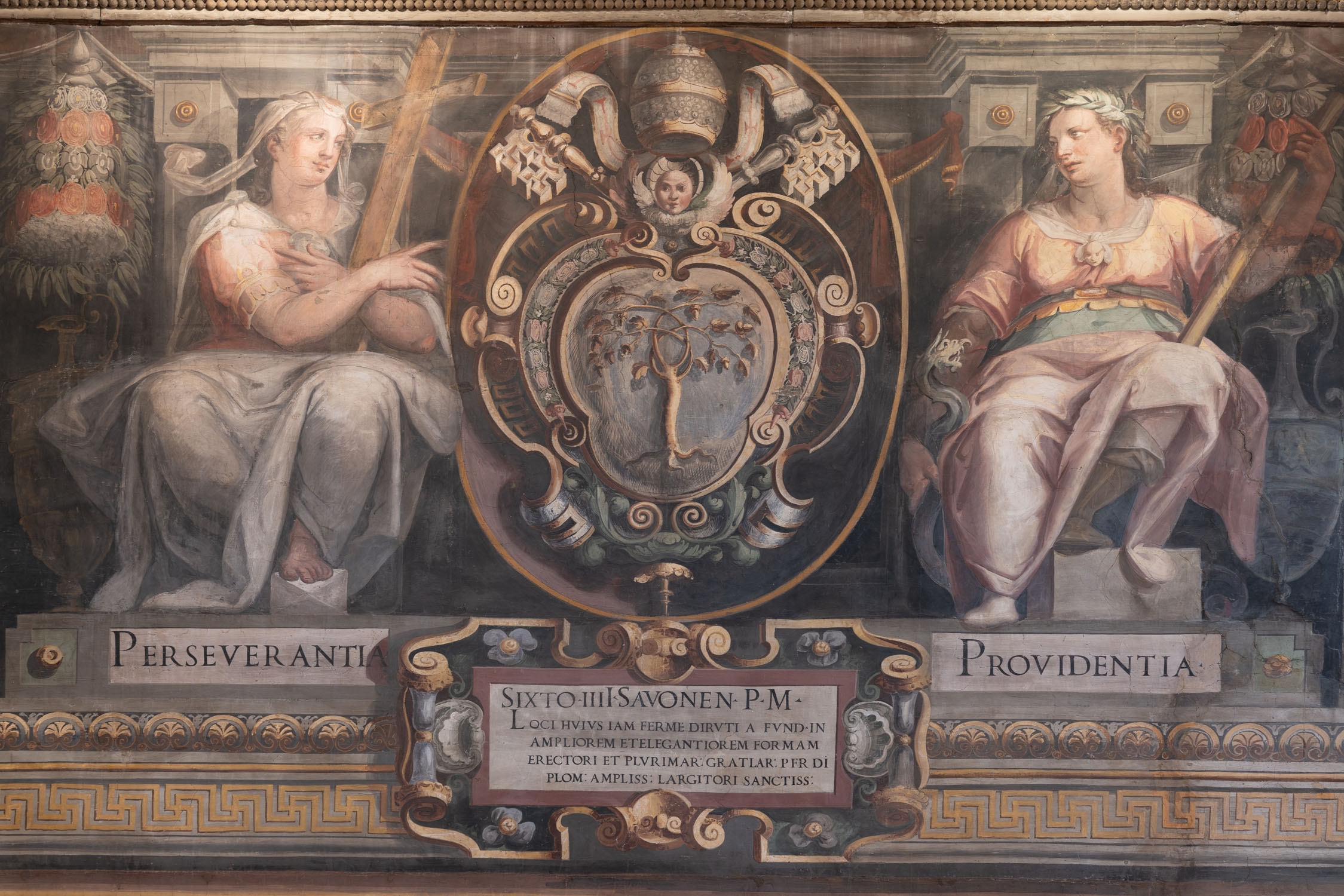
On the west wall, beneath the monumental coat of arms of Sixtus IV della Rovere—founder of the hospital—flanked by the allegorical figures of Perseverance and Providence, the fresco provides a detailed depiction of the main activities carried out within the hospital. It illustrates the roles of all those involved in the great work of charity, care, and hospitality.
Care for Abandoned Children
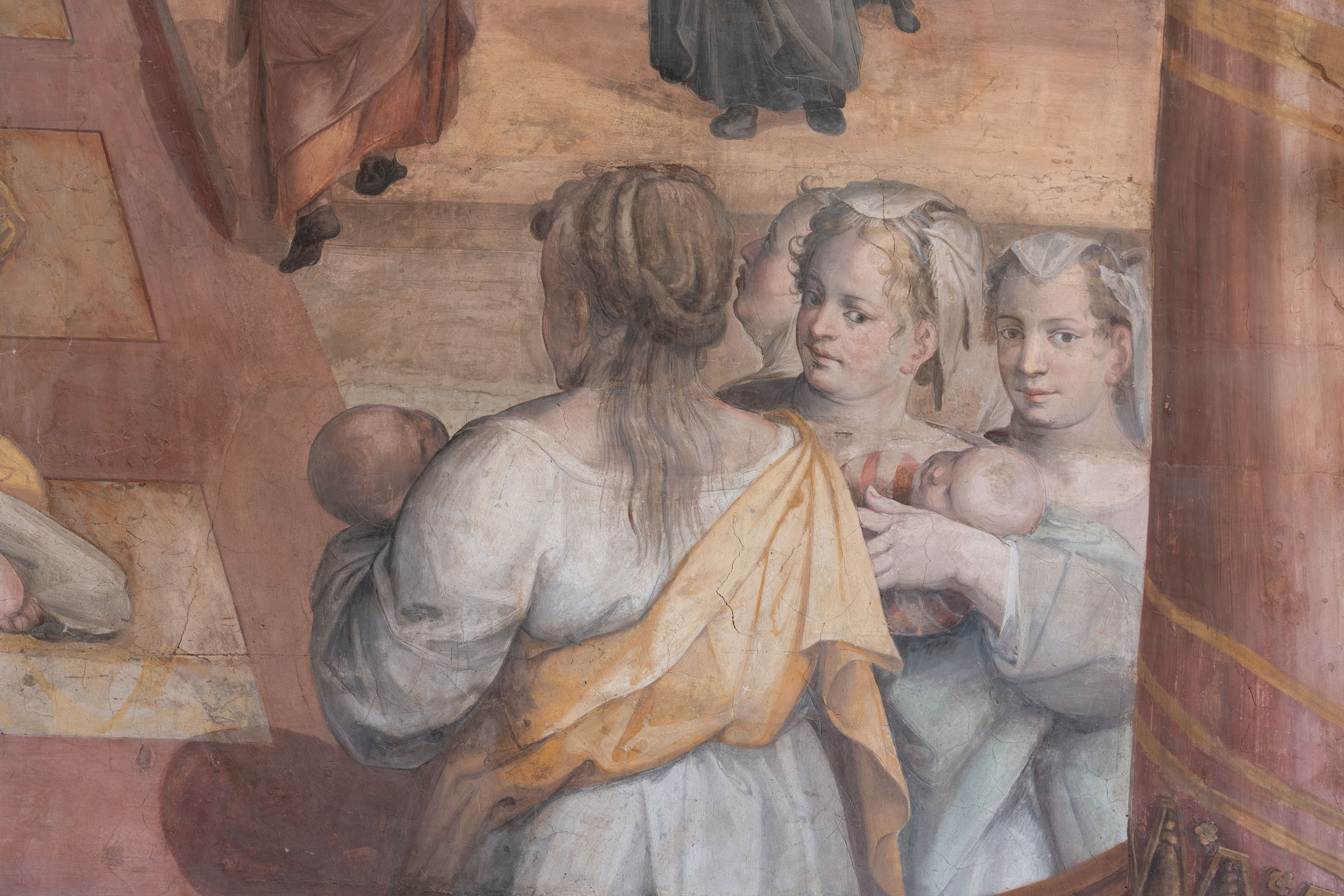
At the center of the scene is the practice of wet nursing. The hospital took responsibility for hiring and modestly compensating wet nurses, primarily from the nearby countryside, to breastfeed and care for the infants’ health and hygiene. As the children grew, their education was entrusted to the nuns until they reached adulthood. Boys were trained in a trade, while girls, whenever possible, were provided with a dowry and arranged marriages. If this was not feasible, they remained within the hospital complex, taking on roles as servants, nurses, or nuns.
Music
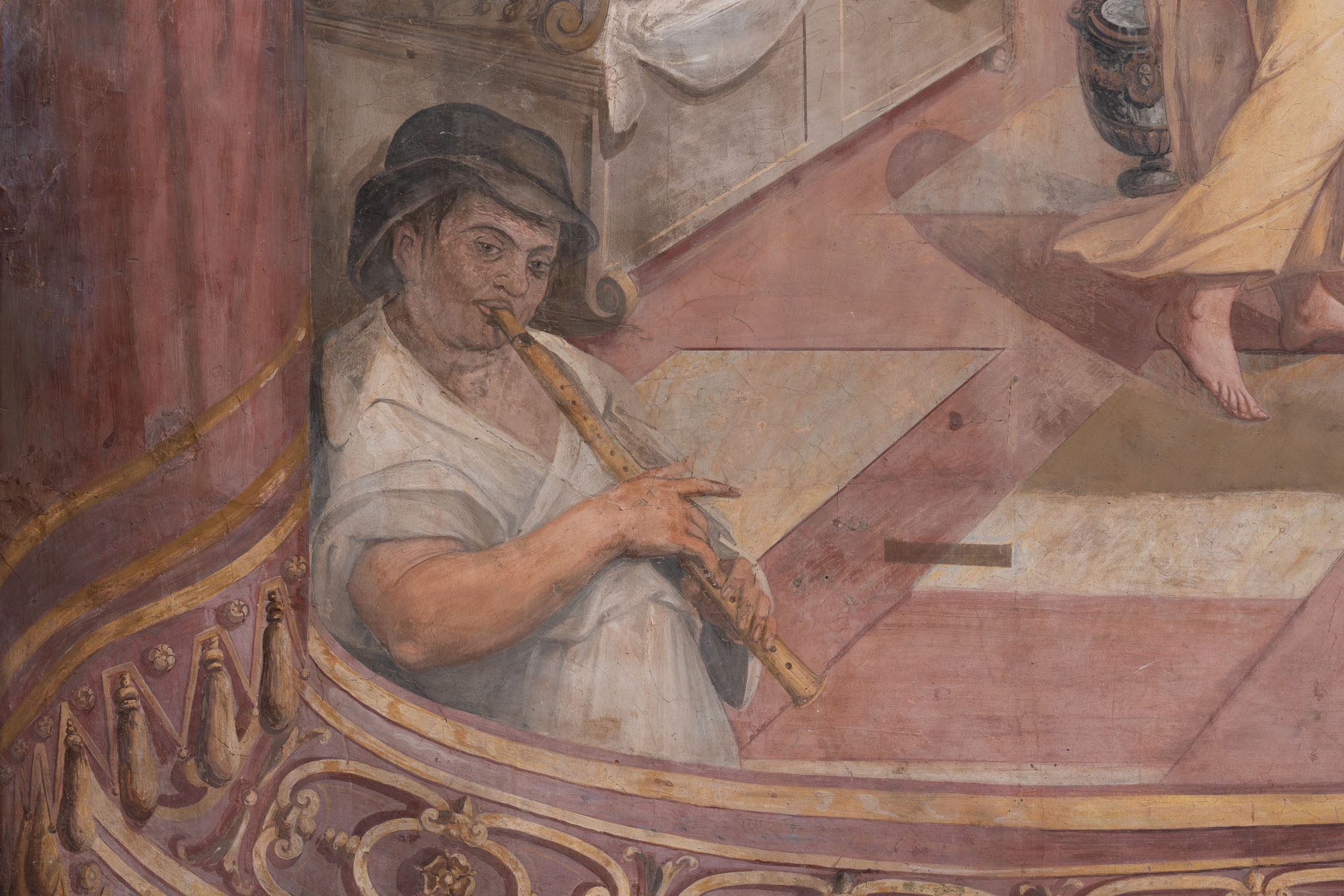
Another activity that brought renown to the hospital was the establishment of a prestigious music school within its walls, rooted in an ancient tradition already mentioned in the Liber Regulae Sancti Spiritus. Renowned musicians such as Pasquini, Frescobaldi, and Zoilo took turns teaching singing, harpsichord, organ, and flute, guiding young students toward professional musical careers. Music was also considered a valuable aid in patient care. An organ, placed between the two hospital wards, provided comfort to the sick during their long stays, and it was believed that the sound of the flute during breastfeeding helped stimulate milk flow.
Wards and Canopied Beds
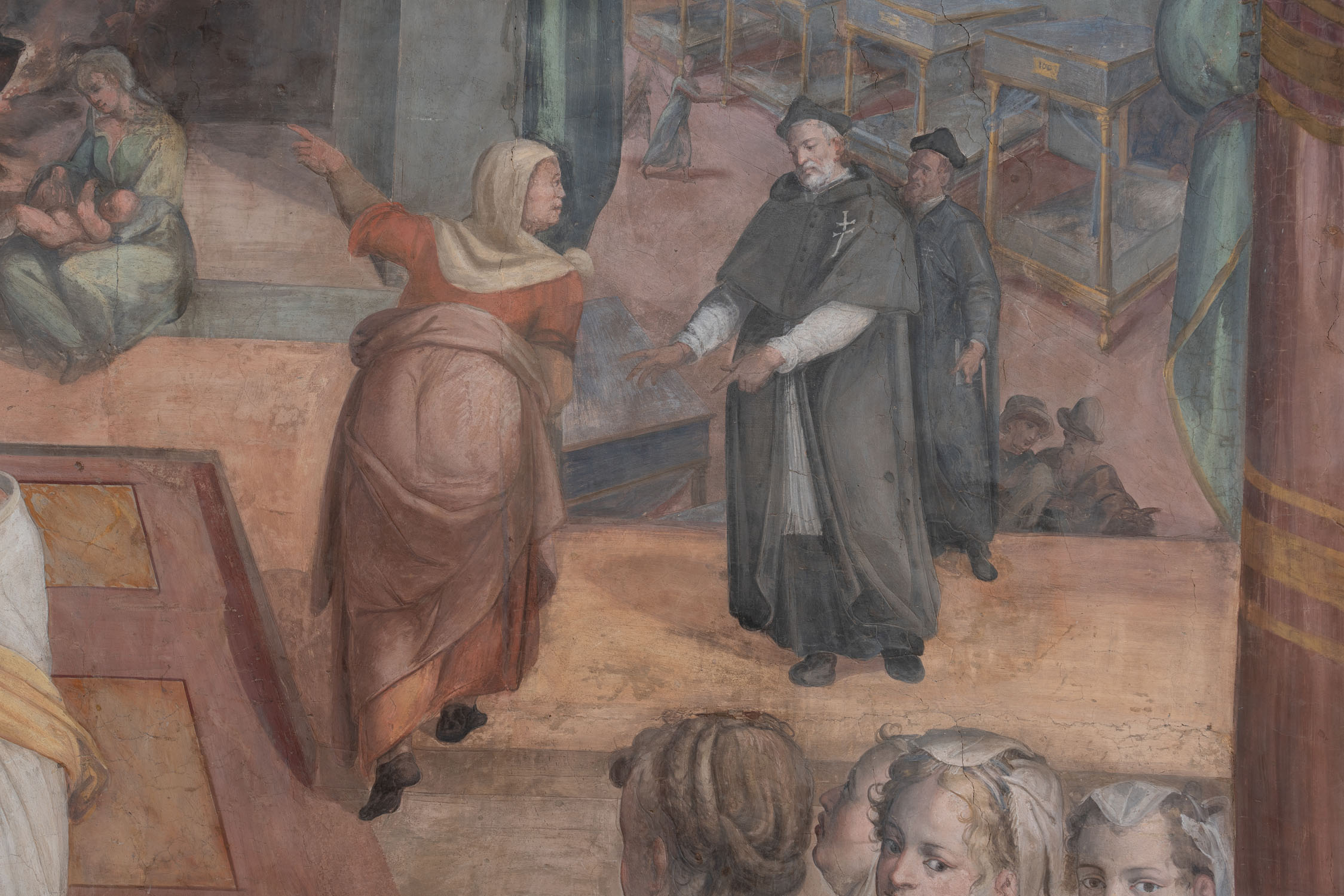
In the background of the grand choral scene, a glimpse of the hospital wards reveals the care and assistance provided to patients. The wards were equipped with numbered canopied beds, complete with blankets and linens, and staffed with nursing personnel under the constant supervision of members of the confraternity.
External Façade
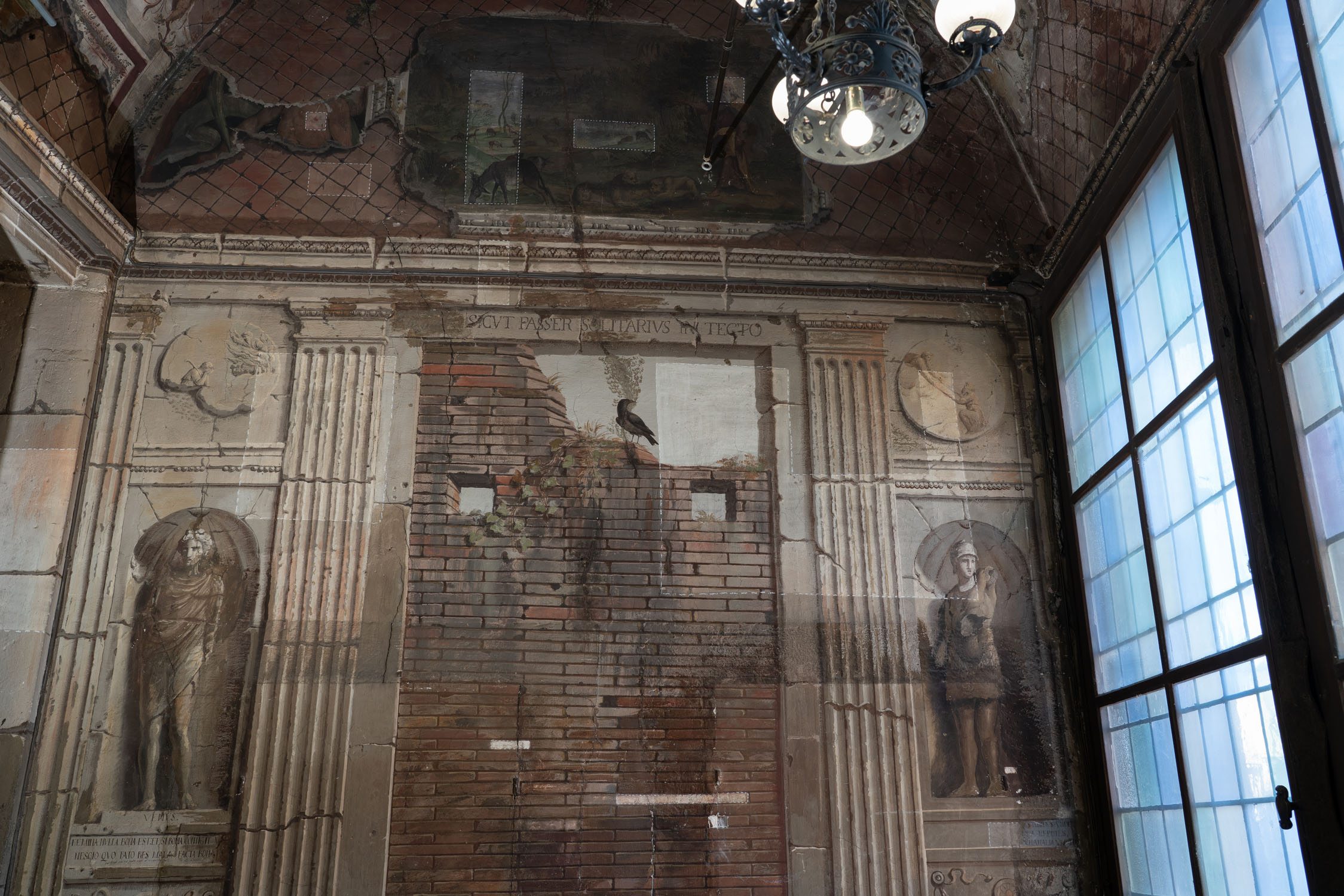
The Sala della Veronica was created within the oldest section of the building, situated between the Palazzo and the Church. Its façade features the famous Serliana, designed as a Loggia of Blessings, which was famously depicted by Raphael in The Fire in the Borgo, a fresco in one of the rooms of Julius II in the Vatican. The room is a small space illuminated by the large Serliana and adorned with 19th-century decorations featuring ruins, a work by Charles-Louis Clérisseau. On all four walls, the artist sought to recreate the illusionistic and romantic atmosphere of a grand ancient building, now reduced to ruins. Classical elements such as niches, statues, and fluted pilasters stand amidst crumbling walls and fragments of grotesques. Amid the overgrown ruins, small serpents and birds appear, to which the artist ascribes symbolic meanings, interpreted through inscriptions placed at the top of the decayed walls.